Is Child Care Working in Australia? [S2-10]
Posted on Wednesday, Jul 15, 2026 | social policyShow Notes
Please leave a comment, particularly if you have your own “Why can’t they just…” question, or email us at whycanttheyjust@gmail.com. We’d love to hear from you.
Find out more about us and how you can support us at https://whycanttheyjust.com.au/, which includes a link to our Patreon site where you can sign up for exclusive content.
Please also feel free to rate and review us, as it does help people to find us.
Music: “Insurrection”
Written by Pierre Chrétien
Performed by the Soul Jazz Orchestra
Courtesy of Do Right Music Inc.
Transcript
15 July 2026
Glenn
Welcome to another episode of Why Can’t They Just, a podcast about politics, policy and getting stuff done. I’m Glenn Davidson and I’m a member of the Labor Party.
Janaline
I’m Janaline Oh, I’m also a member of the Labor Party. I’m a former diplomat and a current climate, environment and anti-racism activist.
Luke
I’m Luke Robertson, I’m a member of the Labor Party, as well as a conservation biology and environmental policy student.
Janaline
Before we start, I’d like to acknowledge that we are all recording this on the unceded lands of First Nations people in Australia, recognising that sovereignty was never ceded, we pay our respects to their Elders, past and present, and extend those respects to any First Nations listeners that we have today.
Glenn
All right, today we’re talking about child care in Australia; the history of government-funded and subsidised child care, and where things are going now, because this is one of those areas that the Albanese government sees as one of its signature policies. The role of government in child care was recently challenged by Senator Pauline Hanson in her National Press Club address, where she stated that she was able to raise her children without a degree or the use of child care. So why should the taxpayer be footing the bill now, and why do child care workers need a university degree?
Now prior to the 1970s, child care in Australia was largely provided by stay-at-home mums, or some charities or community groups and some private providers. There was a clear split between long day care for working mothers and education in the form of pre-school, run by the states. It changed in 1972, when the Whitlam government passed the Childcare Act, which initially targeted not-for-profit child care centres. This was largely driven by the social change taking place that had seen a rise in female workforce participation, so government-supported child care was shifting to become more of a social and economic issue.
So Janaline, is Pauline Hanson right? Do you really need a university degree to look after children? And why should the taxpayer fund something that mothers should just do themselves?
Janaline
There are a number of things in there, so let’s start with why should the taxpayer fund things that mothers should do themselves. I think that comes to the question of whether the society values women’s paid work, whether the society thinks that women should simply stay at home and look after children rather than going back into the workforce after having children. This was a thing, as you say, in the 1970s; there was actually in the public service, what they called the marriage bar, which was that, once you got married, if you were a female officer of the Australian public service, you had to resign, because the assumption was that you would at some point get pregnant, have children and therefore be useless.
I think society has realised that women’s workforce participation is actually good for the economy. It is good for businesses; it leads to better decision-making; it creates economic value for the society. So I think, to that extent, it is useful for the society to enable parents to work. I mean, another option, of course, would be that the mother goes back to work and maybe dad spends some time looking after the children, and some families do this. Vanishingly rare, probably a bit less rare now than they used to be. But I think relying on unpaid parental labour to raise children means that the society firstly restricts the choices of those parents, and secondly it deprives itself of the economic contribution of those parents who could be active in the paid workforce.
But to the point as to whether you need a university degree, firstly you don’t. In order to work as a child care educator, you need a Certificate III, which is a post-secondary technical qualification, so you get it at TAFE. Why do you need any qualification to look after other people’s kids when parents often don’t have any? Looking after someone else’s kids is not the same as looking after your own kids. If you are looking after your own kids, they’re your kids, you want to look after them, you want the best for them, you love them and you will nurture them. I don’t think it is fair to make that assumption of everybody who is looking after somebody else’s children, to whom they don’t have that familial connection.
And it is really important, I think, for educators of very small children to understand basic things about child development; to understand basic things like the duty of care that they have, about the kind of hygiene standards you need to implement; to understand a whole range of things that enable you to look after those children safely. And don’t forget, something like 80% of brain development occurs before the age of five. Now, if that is the case, surely you want the people who are guiding your children during that crucial development phase to have a clue about what that development looks like, and what is actually happening to your child so that they can ensure that they’re getting the best possible guidance through that development phase to take the best advantage of it, to have the best outcomes.
But Luke, you’re working in the sector. Tell me what you think about Pauline Hanson’s views.
Luke
Do you need a university degree? No. But why would you not allow people to get the qualifications that they want? Would you want a mechanic that never learned how to be a mechanic? I mean there’s an enormous volume of kids that a single worker would be dealing with, with different ways of learning and understanding. Why would you not allow someone to upskill themselves and become as qualified as they want? But the idea that you have to have a university degree to do any of this, I think is profoundly misinformed.
Janaline
Yeah, although it is a requirement to have a Cert III if you’re going to look after children.
Luke
Yes, that’s true. That’s a TAFE degree though.
Glenn
Ok, I think that’s an interesting ramble across the subject area and I think what it does point out is that terminology that is being used is not necessarily being used or understood in the same way by the people who are using it. We’ve spoken in that section about child care and early education, and they’re really two different things; you know the child care part is, as you said, Janaline, you know, feeding and cleaning and, you know, making sure that you’ve got hygiene standards in place and so on. That’s one part of it. The other part of course is the early education, which goes to the brain development, the socialisation, you know, just the general sort of educational background, setting these kids up for when they go to school, which is more of a feature these days then what it was then.
And in Pauline Hanson’s case, really she was using the term child care somewhat pejoratively, and really minimising the value of that work that goes on in that sector, which you’ve both touched on in your comments. So I think it is important, I think, when we’re looking at these issues, is to not necessarily let those that are using these terms in a pejorative way set the baseline for the discussion; we need to be very clear in what we’re talking about when we’re talking about child care and early education, because one is subsumed in the other these days; they’re not exactly the same thing.
Ok, so we’ve been talking about what child care and early education is, and what it isn’t, and the system that we’ve got in place now is very different from the environment that Pauline Hanson was alluding to in her Press Club address, so we need to be very clear on that; so we’re not comparing apples with apples here. Things have moved on from that.
Under the current policy, the core of the system is the child care subsidy, in which the Australian government subsidises the fee paid to providers. There’s also a 3-day guarantee which specifies a minimum of three days of subsidised care per fortnight for all families, with up to 100 hours for families that have higher work or study participation commitments. The subsidy is means-tested based on income, and parents still pay gap fees and out of pocket costs. But expanded subsidies mean more families qualify and it’s designed to reduce financial and other barriers to access.
But it’s still a work in progress, and the Albanese government’s trajectory is towards a more universal early childhood education, and it’s been investing in workforce pay increases and expanding centres, particularly in under-served areas. The recognised benefits of all of this work are enhanced child development and greater economic participation, both for parents now and the child later in life. These are all benefits that are substantial, and enduring. The system remains one of subsidised child care rather than government-provided child care and so this shapes the whole child care ecosystem.
Now, Janaline, this is an area of policy that the government is championing as a major successful innovation, and it’s something that the Prime Minister wants to be one of his signature achievements at the end of his time. Is it working as it’s intended?
Janaline
I think you are right to draw a distinction between child care and early education. I think one of the things that was a great achievement of the Gillard Labor government was a shift in the framing of child care from child care to early childhood education. Because early childhood educators are not just babysitters. They are not just making sure the kids don’t break something or fall over or hurt themselves, and make sure that they get fed and go to the toilet. Early childhood education is about having these children in an environment where firstly, they are safe, secondly, they are looked after, and thirdly, that they are in an environment that maximises their development opportunities. And with people who can recognise the different types of development in each individual child and can respond to it. And that is the reason that, under the Gillard government, under the National Quality Framework, there was this requirement that people need to be either studying for a Certificate III or already hold one at a minimum, in order to work as an early childhood educator.
I think, Luke, you are in after school care, which is slightly different; this is looking after school age children out of school hours, so the requirements for people working in that part of the sector are not as rigorous, because it’s a few hours after school and they’ve already been through a whole day of school education.
I do think, though, that the funding model needs to be examined really carefully. Because the way in which it’s delivered, it’s like a voucher system. So the subsidy goes to the parent, and then the parent can use it in a child care centre. So recently the government’s got a little bit tougher about safety standards in child care centres, so child care centres that persistently fail to meet quality and safety standards, the parents who go to those centres will not be able to use their government subsidies. But it’s a very indirect way of making those centres accountable. The fact that the subsidy goes with the family rather than directly to the centre actually really reduces the government’s ability to exercise real oversight over what happens in the centres.
And there is a vast difference between for-profit centres, which account for something like 70% of the sector, and not-for-profit centres. So my daughter, who is now at university, spent two years working in the early childhood sector as an early childhood educator. She was a trainee; she was in the process of doing her Certificate III. She worked for a for-profit provider, and everything that they said in those exposés of for-profit child care providers was true. I mean, she didn’t witness child abuse or safety issues, but what she did see was that they were consistently under-staffed, they paid the absolute minimum. They really went to the edge of legality in terms of giving people breaks, as in giving the staff lunch breaks. She was a trainee so technically she was entitled to a certain number of hours of study time. She never got any of those; she had to do all of her study in her own time.
Her child care centre was run by people employed by a private equity company. All of the major decisions around staffing, around finances were being made by people who were interested in maximising profit to shareholders, rather than delivering the best care and education to children. She moved from that, because after a while she didn’t like it, unsurprisingly, and she got a job in a not-for-profit centre that was run by a board of parents and she came home after her first day and said ‘oh my god, Mum, we have lunch breaks’. She was given all of her training opportunities, she was given time off, she was paid above the award, and many of her colleagues had been there for more than ten years. So one of the things that that parent-run centre had decided, clearly, was that they would treat their workers well and have them stay long term. Which is also good for the children, because it gives them stability.
And I will say, as a parent, both of my girls went through child care at various stages. The first child care that I put my daughter Zari in, so this is the one who went back and worked in the sector later, was a for-profit centre. She was there for about a year, and I reckon there was only one staff member who had been there when she arrived, who was still there when she left, and that was the Director. So every single one of the educators had turned over within one year. Which is also very destabilising, because she would, you know, make an attachment with somebody, they would be there for a couple of months and then they would disappear. She then went, when she got a place - which is another issue, access - to a not-for-profit centre, and when her sister was born, she also went to the not-for-profit centre. I was actually on the board - the parent-run board. We also tried to have a surplus in our budget, but the surplus was not the be-all and end-all of the operation. The purpose of the surplus was to ensure that we had a buffer so that we could help struggling families; so that we could invest in extra equipment; so that we could pay for extra training for one of the educators who wanted to get an extra qualification that was relevant.
The difference between the two is quite striking. It is about centres being operated for the purpose of creating value for shareholders versus centres that are being operated for the purpose of delivering the best outcome for children.
I haven’t had experience with a government-run child care centre, but I’ve got to say that I think there is a very strong case for the government to look very carefully at the funding model and consider actually developing a model where the state governments potentially extend the education system. I would see a very strong case to extend that further down the age range, and actually consider having state government-run child care centres, where you have control over how the educators operate. It is not a profit-based system, it is a system that is focused on the welfare of the children. And the reason that I would propose doing it as a government thing, rather than just funding more not-for-profits - I think there’s no problem with funding more not-for-profits, but I would say that one of the reasons that you don’t have as many not-for-profit child care centres as you do for-profit ones is because it is quite a big demand on volunteer parent boards to run a child care centre. So often a lot of parents are very busy: that’s why they have their kids in child care, and I think it is probably too ambitious to think that every child care centre can be run by a volunteer parent board and so I see a strong case for the government to take a role.
Glenn
There are some really interesting tensions in all of that. You’ve got the government is there as the funder and the regulator, but it’s operating if you like as an adjunct to a market system - a market-driven system - that’s really about profit and efficiency and so on. And we’ve had decades of this argument that the market can always do things more efficiently and better because of higher competition, so that means the standards will be higher and so on and so forth. And we’ve heard that across a range of industries and services. The reality, the lived reality, seems to be somewhat different from that because the problem with the government funding and regulating, it can’t control all of those workforce issues that you spoke about.
It’s done one thing, which you might want to talk about, which is the pay rise for child care workers and why it was so substantial and so out of step with what other workers got. Perhaps we could touch on that before we go on to some of the other issues.
Janaline
Yeah, in terms of the workers’ pay rise, I mean child care workers were just incredibly underpaid, quite honestly. I mean, just think about the responsibility that they have. They have the responsibility for the care and development of our children, the country’s future, and they were being paid barely above minimum wage for this extremely weighty responsibility. And unsurprisingly the sector was losing a lot of workers. So people would get a job in the sector, they would love that job, and then, for example in Canberra, which is where I live, they would be able to get a job working in the public service at a very low level admin job, and earn 50% more than they were getting as a child care educator. Even though they loved the children, many of them couldn’t afford to stay in those jobs. So I think the very significant pay rise for early childhood educators and for aged care workers was a deliberate attempt - which is working - to attract people into the sector and to keep them in the sector.
So you manage the quality through the requirement to have a Cert III, and through the government inspections and through the quality framework, but you pay people enough so that those people who are loving their job and doing a great job with the children can actually afford to keep doing that job.
Glenn
That is such an important point because if you haven’t got that continuity in that environment, then you’re not really delivering a good service. You’re providing the illusion of providing that early education and that care.
Janaline
I would say though, just on the issue of the private sector delivering things more efficiently, I don’t think it’s necessarily wrong. I think the problem here is what is it that the private sector is delivering and is it the thing that you actually want it to be delivering in this sector. What the private sector is delivering efficiently is a service for a price that can be maximised to deliver the best outcome for shareholders. But if what you want them to deliver is high quality, child-centred education, care and development, that model isn’t necessarily going to work. I guess what I’m saying is, children’s education is not the kind of product that private equity is going to deliver as effectively as a not-for-profit run by the parents of those children, or by a government that has a generalised duty of care to the population and that has different incentives and different requirements, different performance indicators. So they are not focused on the bottom line and making it profitable, they are focused on delivering the best education and care, and the best outcomes for those children.
Glenn
All right, so that’s a pretty good summation of where we’re at at the moment and some of the tensions and issues that the government is grappling with. And I think it is important to point out that there are no completely universal systems in the world that cover children from birth, but some other countries approach universal child care in principle, including the Nordic countries, not surprisingly, where they have systems based variously on universal entitlement, backed by strong public provision. In France, there is a universal in principle system but it’s really only fully realised from the age of three. And in, not a country but a province within Canada, Quebec, has a system which is based on universal access, mainly through very low flat fees.
Our system is based mainly on subsidies to parents in a market system. So, Janaline, where does the Albanese government want to land with this signature policy area? Is it realistic? What’s in the way?
Janaline
I mean, I can’t speak for the government. I do think they need to look pretty carefully at the model of delivery, though, because as we just discussed, the subsidy to parent within an open market model makes it very difficult to, firstly ensure quality but secondly to ensure availability. So I think the government is doing the right thing in terms of trying to make sure that child care is affordable. I think they’re doing the right thing in trying to encourage child care centres to open in under-served areas, but I think the market model makes it very difficult to achieve that, because there are some areas of the country that are just less profitable, frankly. Child care providers will gravitate towards areas where people are wealthier, where they can charge higher fees and parents can pay a bigger gap. And what it means is that, in a lot of areas, people just can’t find child care centres.
I mean I have to say, even in Canberra - I mean it’s now nearly twenty years since I was looking for child care places - but it was really difficult. I mean, you actually needed to put your name down at the beginning of your maternity leave to have any kind of prospect of having a place when you needed to go back to work. The model is providing some things, but I think the government needs to look really seriously at other options to enable greater control over availability, where child care centres open, so that less profitable areas are served. And secondly, control over the way in which they’re run so that you don’t have this private equity, profit driven model that gets their profit from charging high gap fees but also from minimising costs. And what does minimising costs mean? It means rostering maybe one fewer educator than you actually need for that session. Not having that redundancy. Cutting into people’s breaks. They’re not at a level of child safety or child abuse, but they are problematic over the long term.
Luke
Yeah, Alan Kohler, I think just before the budget, gave his wishlist for it and he wanted a nationalised child care system, as you described, similar to that of the pre-schools and any other form of public education. Because I think he thought it would be more cost-effective, rather than the long term subsidisation of private centres could increase the cost.
Janaline
I think it does actually come to the sort of core issue that we touched on actually when we talked about public renewables, where we talked about sometimes the market can’t actually deliver because when we talked about electricity for example there’s like a natural monopoly so you can’t really have competition. In this sector I think there is a different issue; there is not a problem with competition, there are plenty of operators out there in the market delivering competition, but I think here the problem is the product is not suited to a market model. Because the product is not a thing. The product is not a service that people can just choose or not choose and it doesn’t really matter if somebody provides a bad service. If you get a bad haircut, it’s not the end of the world, although my daughters might dispute that in the moment.
But if you have bad delivery of early childhood education, you can actually have some quite profound impacts on the children, on the educators and on the families, and on society as a whole. So I think it is about actually recognising that some products and some outcomes are actually just not suited to a market model.
Glenn
Yeah, it’s quite a complex picture really, because private providers, whether it’s churches or other groups, can provide quite effective private schools and people pay a lot of money to send their children to them, so it’s not necessarily that a private provider can’t provide a quality level of education. It really just comes down to how that’s regulated, how it’s measured, how it’s marketed as it were. There’s also that complex issue of the government trying to operate within a market system without distorting it negatively and providing an opportunities for the rent-seekers and the rorters as has happened in the NDIS, to subvert the system for their own profit. It’s not a simple matter to engage in the market, to ensure that you’ve got quality standards that are high, to ensure that everybody has access that they should be entitled to, and to keep it cheap enough to make it affordable.
Janaline
In terms of the education analogy, the thing that is missing here that the school education system has, is a public option. So I think the private providers in the education system, as you say, many of them provide a very good product. Many of them provide a product that people do pay, you know, literally tens of thousands of dollars a year to benefit from. But they also have the public system as a benchmark and as a fall back and as an insurance policy if they can’t afford that private system, or if the private system doesn’t work for them. I think that is why you probably shouldn’t just nationalise child care. I mean, I don’t think anybody is suggesting, not even Alan Kohler, that you should eliminate private provision of child care. But I think, if the government did establish some public option for child care, did actually establish government-run child care centres, then that also helps the government to understand exactly what the benchmarks should be. That’s where you end up with national curriculum, and you end up with national teaching standards. You can do that in child care through having a government provider as an option. And also I think there is an argument for favouring not-for-profit providers in the subsidy provision. And I think that is easier to do if you’re providing subsidies directly to the child care centre rather than as a kind of voucher applied to families.
Glenn
All right, so there’s a lot of really important issues in there for the children and the people who provide the care and the early education to them but this is now part of that broader ecosystem that we operate in in the economy, where households really need to have two incomes. It’s really not an option for a lot of families these days to just have a single income household and one parent stays home as the full time carer. There’s a whole social change that’s happened in terms of the empowerment of women, of higher education standards for women these days and their role in the workforce and you certainly can’t take that sector of the workforce out without having a devastating economic impact.
So child care is all about the children, but it’s not just about the children. It’s about the broader economy. Do you have a perspective on that, Janaline?
Janaline
I mean fundamentally, as you say, it’s a productivity thing. Giving women opportunities to work and encouraging them to have paid employment is not just doing a favour to those women, although I would have to say I am all for giving women choices. But it is also good for the economy. I mean, it is good for companies to have a diverse workforce. And apart from anything else, it’s the numbers. If you have half the population unable to get a paid job because they have to be tied to looking after children at home, then you’re missing out on a lot of skills. You’re losing a lot of human capital in the productive economy. Now I am the last person to say that looking after children is not a productive thing. I think it delivers a huge amount of value to society. But if you are forcing people into that position, if they’re doing it not because that’s the thing that they want to be doing but because they are forced into doing it because of a lack of options, then they’re probably not even going to be doing that very well. There’s plenty of anecdotal evidence that mothers in previous generations forced to stay home looking after children did not necessarily lead to great outcomes for either the mothers or the children.
I mean another one of Pauline Hanson’s policies is to have income splitting, so that a married couple can pool their income, divide it by two, and each of them pays tax on half of the pooled income. Now that sounds like a great idea, that sounds tremendously attractive until you consider that the way in which you maximise the benefit of that is to have one partner basically earn all of the income and the other partner earn basically none. She has explicitly said that one of the reasons that she has adopted this policy is because it will encourage stay at home mothers. And she was quite explicit that she was talking about stay at home mothers and not stay at home fathers.
One of her other policies is to encourage people to have more babies. There is a raft of evidence internationally that shows that one of the biggest drivers of people choosing not to have children is the lack of affordable child care. Because if there’s no affordable child care, rather than give up her job and stay at home looking after babies, many women are choosing actually just to keep the job and not have the babies.
Glenn
All right so that brings us to the end of our time for another episode talking about child care which it is clearly apparent that it is a huge issue. It’s more than just the care of children. It’s about their early education. It’s about setting them up for their lifelong education journey, which will have impacts on how well they do at school and then their subsequent life. It also covers the empowerment and choices for women, not to mention the productivity benefits that they bring to the economy, not to mention the productivity that those children that are better educated and better grounded will bring when they enter the workforce. And there’s also that broader workforce challenges in terms of having enough of the right people with the right qualifications getting paid the right amount of money there. It’s a big and complex issue.
Luke, what would you like to see as an ideal state with the whole issue with child care?
Luke
Oh, I thought that idea of not nationalising but introducing as you said a public option is really interesting. And being able to sort of level out the playing field so the sort of privately owned centres aren’t so incentivised to continue to maximise profits and that can come at a cost of the care of the children. I thought that was very interesting to sort of introduce as you said a sort of baseline like in the public school system, where some private schools might offer, you know, a nice product because they’re, I don’t know, a boarding school or they’re really posh or something. But being able to offer an option as a Plan B for those who can’t get into private schools, or a Plan A for people who just don’t want them.
Glenn
And Janaline, the Albanese government wants to land this as one of their signature policies. Where do you think that landing place should be and what should it look like?
Janaline
Well, I think it’s very laudable for the Prime Minister to want his legacy to include universal access to child care. I just think he needs to think very carefully about what that means. Because as you say and as we’ve discussed today, it’s not a straightforward thing. It’s not just a thing of chucking a ton of money into it and having it all work out. Access is not just affordability. Affordability is an important part of it, it’s not the whole story. Access is also not just having a well-paid workforce, although again that is necessary and important. How that money is distributed and how it is delivered: what universal child care actually means.
Does it just mean that every parent can get access to a subsidy if they can find a child care centre? Does it mean there are child care centres all over the country accessible to all people? Or does it mean actually having a properly regulated system with a benchmark public option, so that people know what a good, well-run child care system looks like and can opt to use it and doesn’t have to use the private equity model.
And I think what that will do is, not only give people an affordable and reliable public option, it will hopefully, if they structure the subsidies in the right way, hopefully encourage parents to give up their time and run not-for-profit child care centres. And thirdly I think it will raise the standards in the for profit sector because they will have to be accountable for having overworked, underpaid educators.
I think it will actually flip the incentive for the private providers from trying to squeeze out as much as they possibly can by cutting costs, to potentially offering a premium product in the way that private schools do. So generally speaking, private school teachers earn more than public school teachers because they have focused the market on delivering a premium product, as opposed to the for-profit child care centres, which have focused the market on delivering the lowest cost product to squeeze as much as they possibly can from the government subsidies.
So I think what the government should aspire to is to leave as its legacy a system of well-regulated, well-run child care centres, that is delivered on a model that gives parents a lot of choice, but which also provides that baseline public service that delivers early childhood education in a similar way, and with similarly structured incentives to the school education system.
Glenn
That was another episode of Why Can’t They Just? The piece that we use for our theme music for this podcast is a piece called Insurrection by Pierre Chrétien, performed by the Soul Jazz Orchestra, courtesy of Do Right Music Inc.
Janaline
You can also hear us on Canberra community radio, 2XX FM 98.3 on Tuesdays between 6 and 7, or via 2XXfm.org.au. If you like our work, consider supporting us on Patreon, via our website whycanttheyjust.com.au.
Glenn
I’m Glenn Davidson.
Luke
I’m Luke Robertson.
Janaline
I’m Janaline Oh, and this is Why Can’t They Just?
Hosts
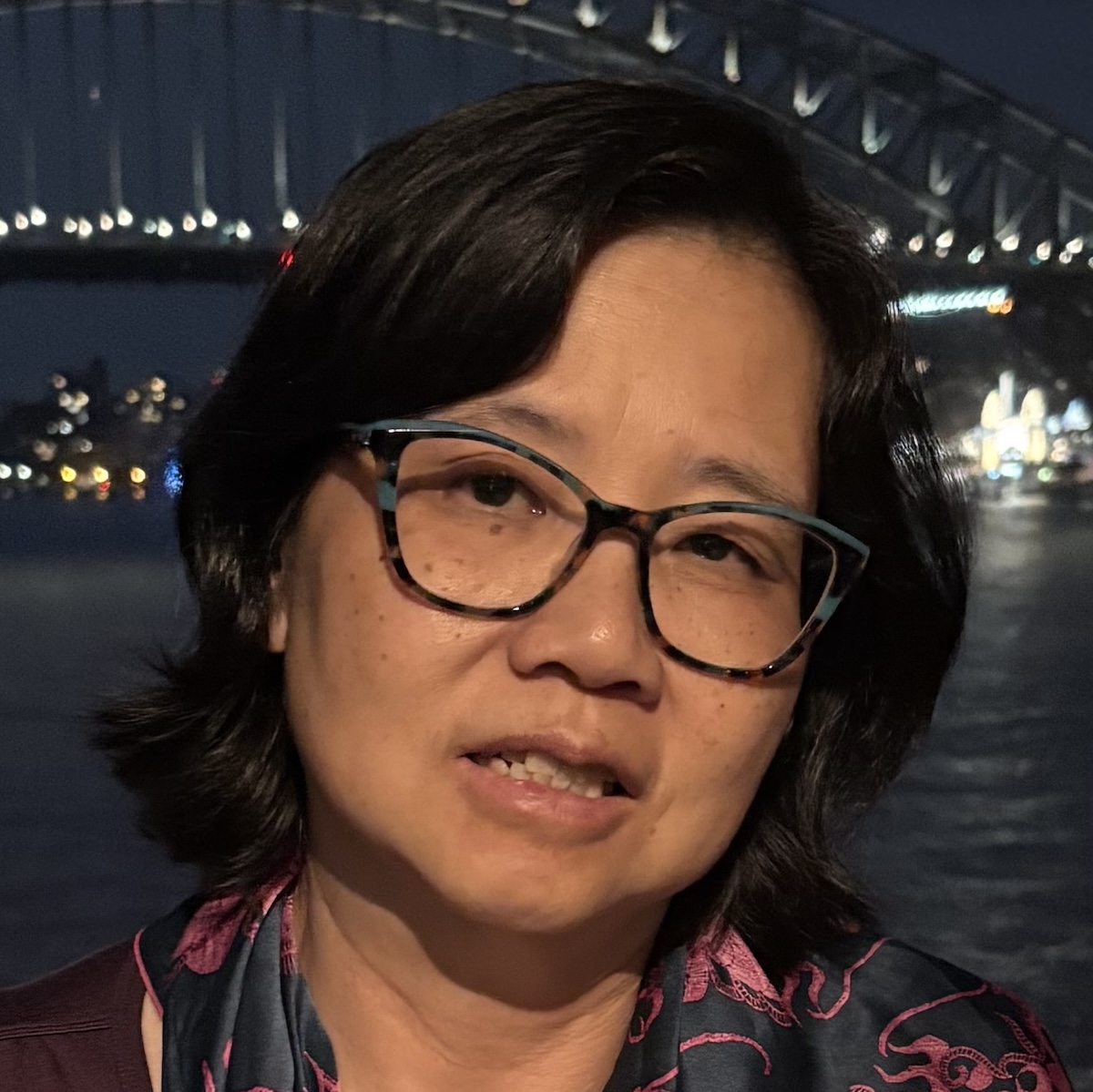
Janaline Oh
Janaline is a former diplomat and current climate, environment and anti-racism activist.
“As a longstanding Canberra-based bureaucrat, I believe in the power of policy to shape and improve lives. I am also acutely aware of the importance of having those policies understood by the people affected by them.
“I started Why Can’t They Just? as way of moving beyond slogans and into what policies really are and what they mean for real people.”

Glenn Davidson
Glenn has a background in education, public service and community radio.
“After far too long being annoyed about the confected outrage, gaslighting, punching down and wilful distortion of facts in our national discourse, I jumped at the opportunity to join the team at Policy 4 People and Why Can’t They Just. I hope to contribute something positive to ordinary people like me understanding complex issues and exercising their vote in an informed way to build and sustain a community and nation that works for all of us.”

Luke Robertson
Luke is a student in conservation biology and environmental policy.
“I got interested in public policy and particularly environmental policy around 2020, seeing the damage that things like the ‘Wild Horse Heritage Bill’ did to Kosciuszko National Park, as well as budget cuts made to the national parks service that eventually worsened the Black Summer Bushfires.
“I joined the Policy for People and Why Can’t they Just team after seeing the hard fought passage of the Environment Protection and Biodiversity Conservation Act and the power of community organising for good. I am now hoping to help with community outreach in all areas of policy to make Australia the fairest and most equitable country that it can be.”