Was COP31 a Failure and Does It Matter? [S3-bonus]
Posted on Thursday, Nov 26, 2026 | climate, international law, foreign policyShow Notes
Please leave a comment, particularly if you have your own “Why can’t they just…” question, or email us at whycanttheyjust@gmail.com. We’d love to hear from you.
Find out more about us and how you can support us at https://whycanttheyjust.com.au/, which includes a link to our Patreon site where you can sign up for exclusive content.
Please also feel free to rate and review us, as it does help people to find us.
Music: “Insurrection”
Written by Pierre Chrétien
Performed by the Soul Jazz Orchestra
Courtesy of Do Right Music Inc.
Transcript
26 November 2026
Glenn
Welcome to another episode of Why Can’t They Just, a podcast about politics, policy and getting stuff done. I’m Glenn Davidson.
Janaline
I’m Janaline Oh. I’m a former diplomat and a climate, environment and anti-racism activist.
Luke
I’m Luke Robertson, a conservation biology and environmental policy student.
Janaline
Before we start, I‘d like to acknowledge that we are all recording this on the unceded lands of First Nations people in Australia. Recognising that sovereignty was never ceded, we pay our respects to their Elders, past and present, and we extend those respects to any First Nations listeners that we have today.
Janaline
So this is a bonus episode of Why Can’t They Just? because we have just had the UN Framework Convention on Climate Change 31st Conference of Parties, otherwise known as COP31, end with no agreement.
This is the second time since the Convention was signed in 1992 that a Conference of Parties has concluded with no agreement; the other time being at Copenhagen, where famously the deal collapsed at the last moment.
So we are doing a special episode and we have here with me: Glenn, Luke and David Mason to talk about COP31, what happened and why I am grumpy about the outcome?
Glenn
Yes, Janaline. I notice that the blame for the failure of COP31 has been sheeted home to the Minister for Climate and Energy, Chris Bowen, who has apparently embarrassed Australia on the world stage. It’s all his fault. Is that true?
Janaline
So this is what the Federal Opposition is saying, which is not a surprise to anybody because the Federal Opposition would have had us not pitch for hosting of COP31; the Federal Opposition complained that we spent too much money on a coffee cart at COP31.
I don’t think that is a fair characterisation. Chris Bowen was not solely responsible for the failure of COP31. Australia was not even the host: Türkiye was the president of the COP; Australia had the role of President of Negotiations. Chris Bowen worked very very hard.
I do think, however, there was a missed opportunity at the COP and it comes to things that we have discussed before in the context of international climate negotiations - and pretty much every other opportunity I’ve had to flog this horse. And it comes down to the obsession with words that have not attracted agreement in the past and the opportunity to change the narrative to a positive narrative around building the alternatives to fossil fuels that would lead to the transition away from fossil fuels. But without using words that many countries clearly find difficult to agree to.
And the reason that a lot of them find it difficult to agree to is not because they hate the planet. It is because they are worried about energy security and they are worried about making commitments that will signal to their people that they are being reckless with their economic futures because of the dependence that those countries currently have on fossil fuels.
So I am grumpy because way back in February, I presented to various parts of the Australian government a proposal to shift that narrative; to actually look at decarbonising global supply chains.
Why? Because that will lead to the transition away from fossil fuels and it’s also something that all of those countries that are currently dependent on fossil fuels, probably with the exception of Russia, are already investing in: all of those Middle Eastern fossil fuel producers; all of those central Asian fossil fuel producers are also investing in clean energy alternatives.
In terms of the importers, every single country in the world has seen the massive vulnerability of dependence on the fossil fuel trade: Ukraine, Iran, the Straits of Hormuz. I mean, who would have thought that the Straits of Hormuz would become a household name? And yet, in 2026, everyone in the world has heard of it. Why? Because that’s why they’re paying so much to fill up their cars.
So I think there was an opportunity, but it was an opportunity that probably needed to be taken at the beginning of the year. Because it was going to take a lot of work to persuade people to move away from traditional positioning that they’ve had over 30 years around the narrative on fossil fuels; to persuade them that this was a way to build the actual pathway that would lead to the outcome.
That is why I’m grumpy. Saying that it’s all Chris Bowen’s fault and he’s a colossally bad diplomat, I think is unfair, but I do think there was an opportunity that he could have taken. And look, I’m not saying it would have succeeded. Maybe it wouldn’t have succeeded, but they didn’t really even give it a go.
Luke
I imagine we’ve all seen that picture, that the Reuters photographer took, of him sitting there looking rather grumpy with all the people surrounding him. I think that’s the poster for the event, I imagine.
I have a few questions. One, which you mentioned obviously, the wording of fossil fuels in there was incredibly contentious.
Do you think the draft text, the initial draft text, changing its mention of fossil fuels, changing it to be more ambitious: because the draft text was too ambitious, do you think that sort of opened the floodgates rather than it just been begrudgingly agreed to, as it was before, to it being a bigger source of tension this time around?
Janaline
I would note that the only COP President that has so far achieved any kind of mention of a transition away from fossil fuels was the UAE. I’m just going to put that out there. All of those climate NGOs were saying, no, you can’t let the UAE be a COP President because they’re an evil petro-state. Well guess what, they got the most ambitious COP outcome ever.
However, it was pretty clear then that only a country like the UAE; only a petro-state with good standing amongst other petro-states was going to be able to get that kind of outcome. Every COP since has failed to do that despite the efforts of people even just to refer to the UAE Consensus where that transitioning away from fossil fuels language resides. There has been a massive struggle even to do that.
I just don’t know why they would have put that on the table. I mean, I think it is very very fair to have a recognition in the preamble that we have got to this place because of the burning of fossil fuels. But I think it is also possible to put that in terms that doesn’t point fingers and say that countries that continue to export fossil fuels are therefore evil.
I think it is possible to craft words that make it clear that this is a historical fact and we need to deal with this fact, and then in the actual commitments to have something that looks more positively at the actual pathway that will transition us away from fossil fuels. And the first step in that pathway is electrification and I think it is really great that they put that forward: the target for 35% of global energy demand to be met by electricity by 2035.
But honestly, instead of saying ‘oh, but only if it’s renewable energy’, I think it would have been a lot more constructive to say: ‘and in addition to that we want to have a commitment for decarbonisation of global heavy industry because we understand that this is better for our economies, it is better for our cost bases. We are all investing in this stuff and this is the way that we make ourselves more resilient to potential future geopolitical shocks, and this is the way in which we actually achieve the goal of transitioning away from fossil fuels.’ Because if you decarbonise heavy industry at the same time as meeting your 35% electrification target, almost by definition that electricity is going to come from zero carbon sources.
So I don’t really understand the strategy behind the COP text, but I’ve got to say, when I saw that text put on the table, yeah, you would have thought they would have had some cunning plan behind that. That would have said: here’s our first ambit, but we’ve got in our back pocket this other thing that we’ve already workshopped with all these people so that we could make a statement and then we can pull back to something that people can agree to.
But no, no cunning plan or if they did have a cunning plan, it didn’t work because nobody stuck to it. So I don’t know what the strategy was.
Luke
Do you think the COP presidency model was a challenge? I saw commentary that there were like last-minute translations that didn’t need to happen, and that roles between the two presidents were not quite clear and they were sort of overstepping. Or do you think that’s sort of a non-issue compared to the text of fossil fuels?
Janaline
I think the main issue was just the approach generally, but I think the co-presidency was definitely a huge challenge because I think Türkiye had views on its role that were not consistent with Australia’s views on its role. Chris Bowen was insisting that he was responsible for the text and the negotiations, and the Turkish environment minister was insisting that Türkiye had final say over all matters to do with the COP. So yes, I do think it was a bit of a challenge.
I mean it was a fix at the end, right? The co-presidency idea was the face saver for Australia when Türkiye had just refused to back down and insisted on hosting the COP. I don’t know who comes out of this looking anything but a failure, because Türkiye did get to host the COP but look at what the outcome was. I don’t think the outcome covers their presidency in glory. So, was it worth it for them? I don’t know.
From Australia’s point of view, I think what was worth it was that it demonstrated to the Pacific Island countries, who are very, very important to us, that we were deadly serious about trying to deliver a COP and that we were trying to deliver a COP that met their needs. And I think that’s where that really ambitious text probably came from.
I don’t know this: clearly I have absolutely no insight into any of the internals of the COP negotiations. But I do think that was probably part of a kind of gesture of goodwill and seriousness towards the Pacific Islands.
Luke
Given that you’ve been to previous COPs, give a sense to us what it looks like. What is the sort of negotiation that actually happens? Does any of it happen before? Or is it sort of everyone’s crammed in there for a week and they’ve got to sort of out in that period of time?
Janaline
Oh no. I mean, the practice of international negotiations is that you try to sort out as much as you possibly can at the lowest possible technical level before you escalate it to ministers. There would have been negotiations going all year.
I mean, I am just a little bit disappointed. I don’t know what they were doing. Honestly, I don’t understand how you would put on the table something that people claimed never to have seen before. Just that is not my experience of international negotiations.
My experience of international negotiations is that you have a whole lot of text floating around for months and months and months. And various bunnies at junior levels in various ministries, in various countries, are communicating and working on it and trying to get mandates for how far they can go to agree to various things. And the main points finally get distilled. And by the time you get to the COP, you’ve got maybe half a dozen important issues that need to be addressed by ministers.
And then you whittle those down even further during the actual first week of the conference. And then by the time all the ministers get there, maybe you’ve got two sticking points that they need to iron out. I just don’t understand the strategy.
And look, to be fair, I was at COP 6 and COP 7. So it is some time since I was at a UN climate conference. I have never been to a post-Paris Agreement conference.
I imagine they’re a little bit different because, when I was negotiating, we were negotiating common rules for the whole world under the Kyoto Protocol, which was a much more top-down kind of instrument. Whereas I think as we’ve said before, I personally think the genius of the Paris Agreement was that it got people to make these Nationally Determined Contributions so that people actually put on the table what they were individually prepared to do and prepared to live up to. So I think the negotiations around those sorts of commitments, like a more bottom-up approach to commitments, would be quite different from the negotiations that I engaged in a million years ago.
Luke
Two questions I guess: what does the absence of American leadership on this issue mean? Did the Americans and their sort of ability to convince the Saudis to, I guess, move out of the way in previous years? Is that something that we need?
And my second question: is what role did the EU’s unwillingness to support adaptation finance have in talks collapsing? What sort of disconnect is there between really wanting this fossil fuel text and then not supporting adaptation?
Janaline
On the question of the Americans’ involvement, I would say: when the Americans are there being constructive, they are fantastic. And they do have this amazing capacity to get everybody to speak reasonably and to negotiate properly and get off their high horses. When the Americans are not being helpful, it is so much better that they’re not there.
I was there in 2000, when the US was still in on the Kyoto Protocol, and they were tremendously helpful in moving the discussions along: hosting contact groups and smaller discussions, and doing a bit of shuttle diplomacy.
2001: George W. Bush had stood up in the Rose Garden and said, ‘no, we’re not going to ratify this because it’s bad for oil and Texas’. And 2001 COP, the Americans were a nightmare: they were genuinely terrible. They were difficult. They were obstructive. They were just deeply annoying.
So given the attitude of the current US administration towards climate change, towards the UN, towards other countries, towards anything other than unilateral action involving bits of hardware that go bang, I think it was probably better that they weren’t there.
In terms of your second question, I think the EU’s refusal to go anywhere near additional financing commitments was a very significant part of negotiations falling over. Because it really did underline the disconnect between the EU’s rhetorical commitments to things like phasing out fossil fuels and the EU’s genuine real commitments to put money behind adaptation for the climate change that the developed world has been largely responsible for creating.
And I don’t want to have gratuitous digs at former colonial powers, but I’m probably going to. I do think that the EU showed a pretty breathtaking degree of arrogance in thinking that agreeing to a rhetorical phase out of fossil fuels was somehow going to compensate for a lack of real money to help real people improve their lives and help to improve their resilience to climate change. Because this is a real thing in developing countries. It is a real, I mean, it’s a real thing in Europe.
And look, I get European budgets are very stretched. I get that France is literally burning and not because of climate change, but because of young people, furious that two thirds of the French education budget is being sucked up on over-generous pensions to retired teachers. And meanwhile: we talked about public school funding. I think the state of our public schools is luxurious compared to the state of some of the schools in France. So the EU has real pressures on its budgets. It’s got real issues with its populations, already being deeply grumpy with governments for giving too much in foreign aid.
I do think, though, that the EU governments needed to make a better case to their own people for why climate adaptation is not just a gift to brown people in foreign countries, but actually an investment in global security and global prosperity. And we’ve had this conversation about foreign aid before, but I think in terms of climate adaptation aid, all of those arguments are so much stronger.
David
I guess my main question is, where do we go from here? And in particular, how can we take forward the work with our Pacific partners who did value the work with Australia so far?
Janaline
In terms of the Pacific, look, I think Chris Bowen deserves a lot of credit. And I think he is not alone in this government in deserving credit for building and strengthening our relationships with the Pacific. I mean, the Solomon Islands Prime Minister is in town this week signing a security agreement following on from the security agreements that we’ve signed with Vanuatu and Fiji and Papua New Guinea, and Indonesia. These are incredibly important.
And I think that relationship building is very important and Chris Bowen deserves a lot of credit for that. I would say that is a concerted and very well-coordinated government strategy led by the Prime Minister and Penny Wong, the Foreign Minister, who have very much done the heavy lifting on that.
In terms of where we go forward, I mean, I have not given up on the idea of getting a COP outcome that actually looks positive and that actually builds that pathway. And I was hoping that Australia could be the hero on this. Failing that, I am continuing to campaign and maybe Ethiopia will be more amenable and more receptive to those arguments.
I mean, unless you’re willing to say the multilateral process has no value - and look, there is a very valid argument that people are putting forward that ‘well, this stuff is happening anyway’. I mean, Chris Bowen said, well, it doesn’t alter the fact that the transition is already underway. Well, if that’s your argument, then what is the point of the COP?
I think the point of the COP is that it can actually accelerate that transition. It can actually make people come to the table with money and with real investment and with real commitment to implement that transition. If you’re not going to do that at the COP, maybe there isn’t any point. Maybe we should try to strike bilateral deals with people.
David
I suppose that, yeah, that my sort of general view on public policy is that you’re trying to find the space between the impossible and the inevitable and even when it’s inevitable, make it happen faster. So what do you think of some of the calls we’ve seen: it’s time to abandon the extremely difficult consensus processes and go to a majority vote of some kind? Just my initial take on that, if you haven’t got the major energy suppliers and users on board, then you can have all the majority votes you like: that doesn’t really enter into reality, rather just comforting conscience-assuaging politics.
Janaline
I think you are so spot on on that. I mean, majority voting is great in systems of national government because if you have a majority voting parliament, you can pass a law and that law is enforceable by national courts and national law enforcement. And so the majority vote actually binds the minority.
In an international context, unless you’re in the European Union where they have a qualified majority rule, where the minority has agreed through a treaty process that they will suck up the outcome, it’s meaningless.
I mean, look at the convention to outlaw nuclear weapons. Not a single nuclear weapon state is a party to that treaty. So what is the point of it? It is a great articulation of a moral position, which I totally agree with. And look, I am not opposed to symbolic gestures: I think symbolism is often underrated. There is value in a big moral statement at an international level. But having said that, in practical terms, if you actually want a thing to deliver an outcome, there is no point in having some sort of majority vote that the parties who have voted against it have no intention of implementing.
It’s like having these plurilaterals, you know, this Just Transition process that was hosted in Santa Marta, in Colombia, by the Colombians and the Netherlands. The next one is going to be hosted by Tuvalu and Ireland. And they are terrific processes and they are very important because I think, as we discussed in a previous episode, Luke, they identified some of the practical barriers that countries have actually transitioning away from fossil fuels and that is really really valuable stuff. But a plurilateral on climate change doesn’t help if most of your major polluters - importers or exporters - are not part of it because if your biggest users of fossil fuels are not committing to reducing their use of fossil fuels, you’re not going to get emissions reductions.
So, this whole thing about ‘oh, its the system and its consensus and that’s a real problem, and we should just have some sort of majority voting’: that only works if the minority agrees to be bound by the majority outcome. And there is no indication that anybody is willing to go there. You can’t enforce it. It’s just as simple as that.
If a minority party in Australia votes against a piece of legislation that passes the Parliament, that legislation becomes law, it’s a real thing and the minority and everybody else in the country has to abide by it.
David
It seems to me like some of the climate activists have the same mistaken view of the sweeping powers of the international system that the worst of the conspiracy theorists in One Nation have: that there is this one world government just waiting to issue dictats - and that’s not what happens.
Janaline
Yes, I think the limitations of the international system are very glaring.
Glenn
Yes, all very interesting. The processes and the relationships and so on just make an already challenging problem all but impossible. So what does this mean for the climate going forward? Are we all doomed?
Janaline
Well, we’re probably all doomed. I don’t know. The overshoot is real and we do need to do something. I mean it is urgent. Like, I don’t want to trivialize this in any way, but one of the things that does frustrate me is that all the people who are talking about how urgent it is are actually digging in on language that is making it harder to build that pathway to get to the outcome.
A number of things are true: the transition is underway in most countries. Even the United States, even with a federal government administration that openly mocks climate change and says it’s a hoax and doesn’t like windfarms; even in the United States, there is unprecedented investment in clean energy and in clean industrial processes. It could be a lot better and I hope it will be a lot better under new management, but I would say Russia is probably the only country with a significant industrial base that is not actively decarbonizing.
But the problem is the pace is too slow and decisionmakers in important countries like Japan, like India, are still too conservative about their embrace of zero carbon technology for industrial processes.
So the challenge is to change those people’s minds. Now one of the ways that you can help to change those people’s minds is to change the investment climate around investment in clean energy. And one of the ways in which you can do that is to send a very strong signal from an international meeting that you have a global consensus that you want to invest in this new stuff.
And that delivers a message to business, and it delivers a message to national governments that this is a thing that will be supported. And if on top of that you also put some real investment dollars into some sort of big deal like the deal that we signed with Korea - that was a fantastic outcome just all by itself that will reduce emissions. So if we can have more of that stuff, that would be amazing.
I see the potential value of the multilateral system in delivering a really strong message that all of these countries agree that this is a good idea and want to invest in it. The transition is underway. It is going to happen. It is inevitable but it’s not happening fast enough and we need to be looking at ways of accelerating that.
People who care about the outcome need to be focused on the outcome and the outcome is not words about what went wrong in the past. The outcome is what is actually going to reduce emissions to get us to a zero carbon future. And the way in which you do that is you focus on building the pathway.
Glenn
That was another episode of Why Can’t They Just? The theme music for this podcast is a piece called Insurrection by Pierre Chrétien, performed by the Soul Jazz Orchestra, courtesy of Do Right Music Inc.
Janaline
You can also hear us on Canberra community radio, 2XX FM 98.3, on Tuesdays between 6 and 7, or via 2XXfm.org.au. If you like our work, consider supporting us on Patreon, via our website whycanttheyjust.com.au.
Glenn
I’m Glenn Davidson.
Luke
I’m Luke Robertson.
Janaline
I’m Janaline Oh, and this is Why Can’t They Just?
Hosts
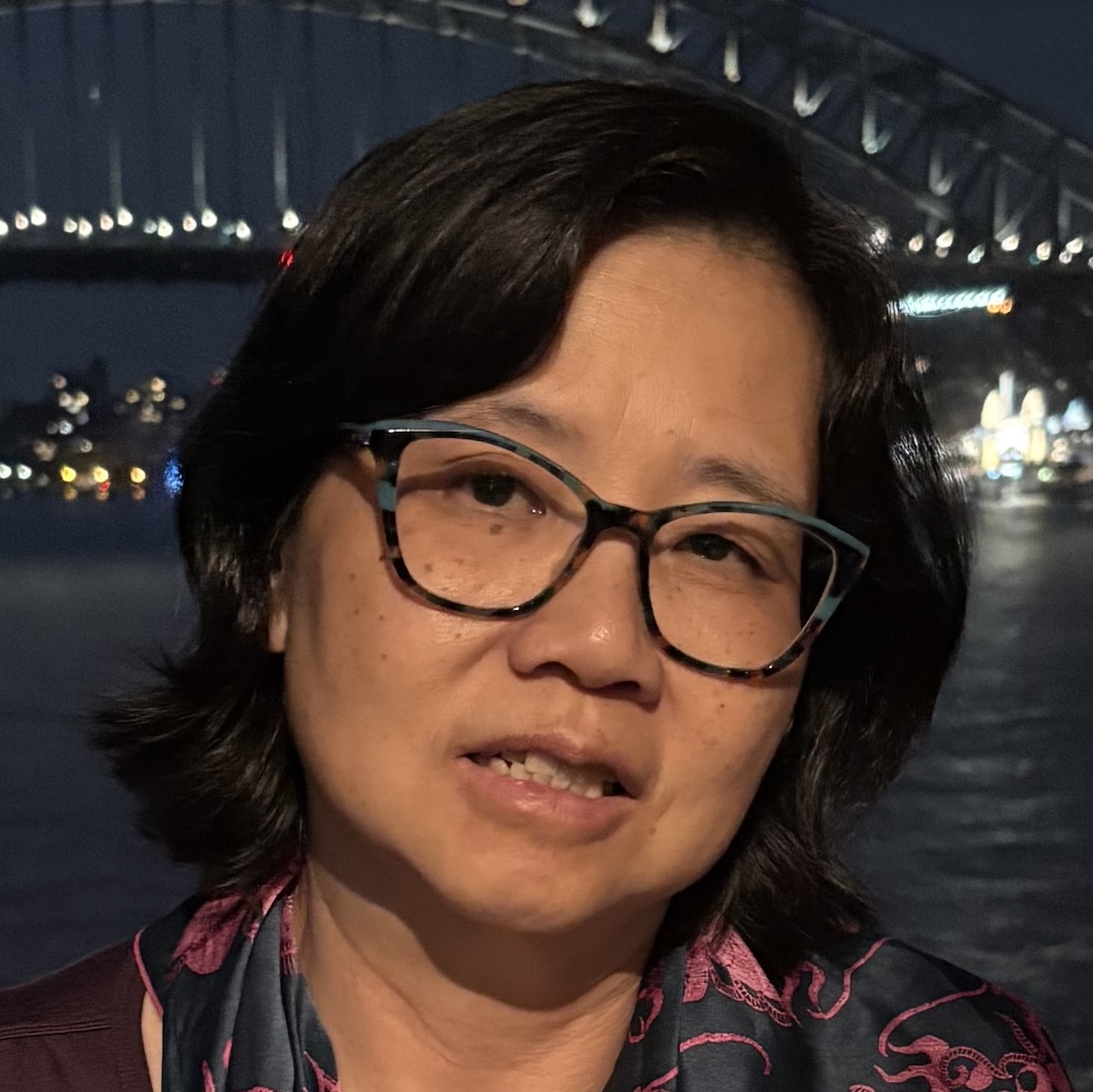
Janaline Oh
Janaline is a former diplomat and current climate, environment and anti-racism activist.
“As a longstanding Canberra-based bureaucrat, I believe in the power of policy to shape and improve lives. I am also acutely aware of the importance of having those policies understood by the people affected by them.
“I started Why Can’t They Just? as way of moving beyond slogans and into what policies really are and what they mean for real people.”

Luke Robertson
Luke is a student in conservation biology and environmental policy.
“I got interested in public policy and particularly environmental policy around 2020, seeing the damage that things like the ‘Wild Horse Heritage Bill’ did to Kosciuszko National Park, as well as budget cuts made to the national parks service that eventually worsened the Black Summer Bushfires.
“I joined the Policy for People and Why Can’t they Just team after seeing the hard fought passage of the Environment Protection and Biodiversity Conservation Act and the power of community organising for good. I am now hoping to help with community outreach in all areas of policy to make Australia the fairest and most equitable country that it can be.”

Glenn Davidson
Glenn has a background in education, public service and community radio.
“After far too long being annoyed about the confected outrage, gaslighting, punching down and wilful distortion of facts in our national discourse, I jumped at the opportunity to join the team at Policy 4 People and Why Can’t They Just. I hope to contribute something positive to ordinary people like me understanding complex issues and exercising their vote in an informed way to build and sustain a community and nation that works for all of us.”