Defence Spending, National Security and AUKUS [S1-05]
Posted on Sunday, Sep 14, 2025 | defence, national security, foreign policyShow Notes
Please leave a comment, particularly if you have your own “Why can’t they just…” question, or email us at whycanttheyjust@gmail.com. We’d love to hear from you.
Please also feel free to rate and review us, as it does help people to find us.
Music: “Insurrection”
Written by Pierre Chrétien
Performed by the Soul Jazz Orchestra
Courtesy of Do Right Music Inc.
Transcript
Callum Sinclair
Welcome to Why Can’t They Just, looking at politics, policy and getting stuff done. My name is Callum Sinclair. I’m a member of the Labor Party and joining me today is Janaline Oh.
Janaline Oh
Hi I’m Janaline Oh. I’m a former diplomat, also a member of the Labor Party and I would like to acknowledge that Callum and I are both recording this podcast on traditional lands of Australian First Nations people in different parts of the country, and I would like to pay our respects to their elders past and present, and acknowledge their continuing connection and custodianship of this land.
And extend those respects to any First Nations listeners that we might have.
Now, perceptive podcast listeners will notice that Callum is not William. What has happened is William has gone overseas, he is now apparently having four months in Europe, which sounds tremendously fun, and Callum has very kindly agreed to step into co-host in the meantime, as well as do the editing, so I’m tremendously grateful to Callum. So welcome Callum.
Callum Sinclair
Thank you, Janaline. So today is the 20th of August and this episode is going to focus on AUKUS and Australian defence in general. You mentioned in our earlier tax episode that Australia should be pursuing an increased defence spending.
Why can’t Australia just reduce defence spending and not get into any more bloody wars?
Janaline Oh
That is such a good question, and I think it is a very valid question because I know that a lot of people, particularly, you know, progressives, don’t like war. Nobody likes war. They don’t really understand why we would not be using that massive military budget to invest in social spending, so health and education and all of those really important things.
I used to hold those views and after 30 years in the Australian diplomatic service, including four postings in various parts of the world, I have come to the conclusion that a country like Australia does need a significant defence budget and does need to take the defence of Australia seriously. So I’m afraid I’m going to take a slightly long winded route to answer that question, but keep it in your mind because I am going to answer it.
But let’s just talk first about what are the actual strategic threats to Australia now.
Now I would say, and I think this is a thing that many progressives would agree with, climate change is probably the number one strategic threat to the world. We are already seeing the effects of climate change in increased frequency and intensity of natural disasters.
And we absolutely need to be spending on mitigation, in other words, reducing greenhouse gas emissions and on adaptation, making ourselves more resilient to the kind of climate change that’s already baked into the system. And this I would say is absolutely a national security issue. Now I refer people back to our episode on climate change to talk about the emissions reduction side of that, and my views on Australia’s potential contribution to global emissions reductions.
But I think climate change is definitely up there, so arguably you can say, well, OK, if climate change is the number one threat, we should be diverting our military spending into adaptation, resilience, you know, helping other countries decarbonize, etcetera. We should absolutely be spending money on those things.
But I am also here to argue that we also need to maintain a military budget. Why? Because let’s look at a couple of other strategic threats. One of them, I have to say, quite a new one is the approach to foreign policy that the new US administration under Donald Trump is taking. They are taking a very aggressive approach towards their traditional allies.
One of the great strengths of US security in the world over the last 80 years, since the Second World War, has been a very deep and extensive system of alliances. The US has alliances with Europe and Canada through the North Atlantic Treaty Organisation or NATO, it has alliances in Asia with Japan, Korea, Australia and New Zealand.
The Trump administration has taken the attitude that these alliances are just costing the US tons of money. They’re not getting good value out of it, and countries need to step up and defend themselves. Now, on the last point, I think Donald Trump has a point, but I think he is wrong to say that those alliances are not benefiting the US. The uncertainty that is created through his treatment of allies and the random tariffs that he’s imposing on people are really genuinely disrupting both the US economy and regional economies, including export dependent countries like Australia, creating a lot of economic and strategic uncertainty that is not good for Australia, so we need to respond to that in an economic sense, in making ourselves more resilient economically. And we talked a little bit about this in the tax episode, but we also need to be making ourselves more resilient and more capable of defending ourselves in a military sense. And I guess this comes to Donald Trump’s point that the allies actually need to be investing more in their own defence.
The third strategic threat that I think is actually very real is China. The Chinese Communist Party is aggressive. It is not expansionist in the sense of Russia invading Ukraine. It is not invading other countries to try to take them over and run their territory. China has never really taken that approach except on its own borders. It has never been a colonial power in the way that European powers have.
So we see in the South China Sea, they have taken very aggressive actions to interfere with commercial shipping and aviation to extend claims over territory that other countries have claims over. To say that China does not have an aggressive and expansionist foreign policy is taking a far too narrow view about what expansionism means.
The other thing that China does very aggressively is pursue its interests in other countries and what I mean by this is, for example, there have been at least three occasions that I can think of in the last 10 years where local councils have wanted to run Uyghur film festivals. Now people may be aware that Uyghurs are an unfavored minority in China.
And councils in Australia that have tried to run Uyghur film festivals have been actively suppressed by Chinese consulates. So you’ve had Chinese consulates go to local councils and effectively bully and intimidate them into cancelling these festivals.
There are two people who were from Hong Kong who have come to Australia. So Ted Hui, who was a lawmaker in Hong Kong, has recently been given asylum. He and Kevin Yam, who is an Australian citizen who used to work in Hong Kong, were associated with the Hong Kong democracy movement.
They’re now in Australia and Chinese authorities have actively been trying to arrest them illegally in Australia. They have sent flyers out into their neighbourhoods with their pictures on them saying if you see these people, they are wanted criminals in China, go and contact this number at the Chinese consulate. That level of interference in the lives of Australians is actually quite unprecedented in terms of the way in which you conduct your foreign policy, I mean it is direct and blatant interference into the domestic affairs and the lives of Australian citizens.
Penny Wong has raised this with her Chinese interlocutors. The Prime Minister has raised this with his Chinese interlocutors, but they are still doing it. I say this to counter the arguments that China is not going to invade Australia, so China is not a threat.
I don’t see any real threat of a Chinese military invasion into Australia. But that doesn’t mean it’s not threatening our interests, and it doesn’t mean it is not a strategic threat.
Why does this mean we need to increase defence spending? Because we need to protect ourselves against this threat. What is the actual threat then, if China’s not going to invade Australia, then what it means is that having a bunch of little submarines running around the Australian coast to stop an invasion is probably not the most useful thing to protect our interests.
Where might China actually threaten Australian interests? China might decide that because of a political crime by an Australian government, such as criticising some action by the Chinese Communist Party, China wants to choke off Australia’s trade through the South China Sea. Now about 70% of our trade comes through the South China Sea. It would be quite significant if we were to lose that access route.
And China has proven its capacity to take really quite radical trade measures against countries for political reasons. So, for example, Norway, Canada and the UK had their trade cut off completely after their respective leaders met with the Dalai Lama, who is, you know, the spiritual leader of the Tibetan people, another unfavoured minority in China.
China has been quite happy to cut off rare earth exports to Japan because of a political disagreement. In the longer term, that has actually worked to China’s detriment, because whereas they previously had a near monopoly on rare earth supplies throughout the world, that action has actually made all of its export markets think very carefully about sourcing from elsewhere, because they have realised that they don’t want their rare earth supplies to be subject to the whims of the Chinese Communist Party.
So when I say China is a strategic threat, I think it is a real threat. I wouldn’t downplay it just because Chinese warships or planes aren’t going to, you know, come and invade the Australian mainland.
Callum Sinclair
If China is such a strategic threat and an authoritarian regime, why has Europe, the US, Australia and Japan allowed them into the World Trade Organisation? If it inevitably strengthens their economic and military power, why can’t we just stop trade with China?
Janaline Oh
Well, you know, it’s funny because I think Donald Trump would like to stop trade with China, and I think he would like to stop everybody else’s trade with China. Of course, what he’s actually doing is stopping trade with the US and stopping everybody else’s trade with the US.
When China first applied to join the WTO, it was in the 1990s. Remember in the 1990s was the great opening. There was a real sense that the Mao era totalitarianism had passed, that China was becoming more open. And remember in the early 1990s we had the fall of the Soviet Union; we had glasnost, which was the opening of political speech in Russia in the 1980s under Mikhail Gorbachev. We had perestroika, which was the reconfiguration and liberalisation of the Soviet economy, which ultimately led to the collapse of the Soviet Union.
If you look at it in the historical context, the thinking in the West was that we should be encouraging China’s opening and that by embracing them into the international trading system, we would actually be creating the conditions for the emergence of a Chinese middle class.
It turns out that more prosperity did not necessarily lead to the people demanding more political freedom. Or at least that to the extent that it did, that could be squashed by an ever more repressive police state and by ever more investment in domestic security.
Over the next 30 years, China has become the major trading partner, the number one most important trading partner for about 120 countries. It’s really hard at that point to say, oh, we’ll just stop trade with China. China is a critical supplier of a lot of really important things that the rest of the world needs. I talked about rare earths. Critical minerals. Batteries. You know, a lot of the things that we need for the renewable energy transition.
Now countries like Australia and the US and Japan and Korea and the European Union are now looking at alternative supply chains. They are looking at developing domestic supplies of these kinds of things, a Future Made in Australia, which is the government’s kind of flagship manufacturing policy, is all about trying to create new supply chains.
In the last 10 years, there’s been this sort of rash of what economists call ‘friend shoring’: countries in the West trying to diversify away from specifically China, but also Russia by investing more in capacity in so-called friendly countries. That’s led to a massive investment in places like Mexico.
The way in which the global economy is currently structured, you can’t just cut out China, and aside from anything else, I think it’s actually kind of dumb to do that.
I believe that countries with fundamentally different values and fundamentally different interests can still cooperate to mutual benefit. We still need to trade with China and it is in our interests to keep that dialogue open.
In climate change, it is absolutely 100% in our interest to cooperate with China. China is the world’s biggest emitter of greenhouse gas emissions. It’s the world’s biggest investor in renewable energy. It is also the world’s biggest opener of coal mines and new coal fired power stations. So for all of those reasons, we need to keep talking with China. We need to keep working with China and we need to keep those lines of communication and cooperation open.
And I think the previous government’s approach, I think many of the things that they said about China were just offensive and unnecessarily so.
China’s response, I think, was also quite unreasonable. They refused to speak to Australian ministers for about two years. They banned a whole lot of Australian commodity exports into China, which again, I think, in the longer term, was actually not in China’s interest because it meant that those exporters actually found other markets and actually learned how to diversify their supply chains. So I think in some ways it was actually good for Australian suppliers, but it was very painful.
I think just saying you’re a bad country, so we don’t want to have anything to do with you has real limitations in a world where we have a lot of really pressing global problems that need global cooperation, and climate change, as I said, number one security threat not just to Australia but to the whole world, and that is absolutely something that needs global cooperation. And we can’t have that if we call people bad countries.
All people and all countries do bad things and good things, and the world is nuanced and humans are nuanced and so demonization I don’t think is actually a constructive way of conducting your diplomatic relations. Which is part of my problem with the Trump administration’s approach to diplomacy.
Callum Sinclair
While not headlining right now, war with China over the issue of the Taiwan Island has been a recurring topic in sections of the Australian media. Given the experience you’ve talked about, being a diplomat in Hong Kong and Beijing, should we worry about China conducting an amphibious assault on Taiwan? And if America asks for Australian involvement, should Australia become involved in this foreign conflict?
Janaline Oh
Yeah. So that is also a very good question. So firstly, I will say yes, we should be concerned. I think China would like to take back Taiwan. I think China has now blown up its chances of the Taiwanese agreeing to return to the motherland, by its behaviour in Hong Kong.
So when the British handed Hong Kong back to China at the end of its 99 year lease, China’s promise to the people of Hong Kong was that they could maintain their British legal system. They could maintain the kinds of economic and political freedoms that they had previously had, which were not enjoyed by people on the mainland. They would still be part of China. They would still be recognised as Chinese sovereign territory, but they would be allowed to operate in a different way.
In the last five years, that promise has evaporated under the weight of the national security law in Hong Kong, which is increasingly turning Hong Kong into just another province of China. There are no longer two systems.
Why is this relevant to Taiwan? Because part of the point of offering one country two systems to Hong Kong was to demonstrate to the people of Taiwan, who had by 1997 had their first round of democratic elections and an actual peaceful transition of power to a different party; it was the promise to the people of Taiwan that if you come back to the motherland then we will do the same deal for you. You can have your own system, you will just be part of the Chinese sort of sovereign jurisdiction.
Taiwanese people have seen what’s happening in Hong Kong. There are a lot of Hong Kong refugees now in Taiwan and I don’t think anybody believes in that anymore. Having said that, that doesn’t mean that China has reduced its ambitions over Taiwan. And frankly, the Communist Party has put itself in a pretty awkward position here, because for the last, you know, 80 years they have been saying Taiwan is an integral and inalienable part of China, and it has to come back to the motherland. And it has instilled this into generations of Chinese who genuinely believe this. If you talk to anybody from mainland China, they will tell you that Taiwan is an inalienable part of China.
There is a lot of historical debate about this and looking through the legal and political history of Taiwan does not support that view. I think there is a very credible international legal argument that Taiwan is not and has never been part of Communist China.
But leaving that aside, very few people in Taiwan want to change the status quo. Status quo is Taiwan is de facto its own country. It has its own military. It has its own government. It is clearly self administered. It has relations with other countries, even if they’re not completely formal diplomatic relations. It has a place in the world. It has its own identity. In any objective sense, you would have to say Taiwan is a country.
The Taiwanese people, though, are happy to go along with the kind of ambiguity that says we will not say this out loud and we will not try to exert the rights of a normal country by, for example, trying to join the UN or trying to join international organisations in our own right as a country.
So where that takes us in terms of a Chinese invasion is, I don’t think China will invade Taiwan until it is very, very confident that it can win: that would have been a very, very risky calculation. The mixed messages that the Trump administration has given out over its willingness to come to the defence of Taiwan in the event of a Chinese invasion has significantly changed the potential calculation over China’s likely success.
So previously the Taiwanese defence strategy had been, essentially, this sort of porcupine strategy to hold off the invaders until American aircraft carriers could arrive and save the day. If those American aircraft carriers don’t arrive, that makes the whole calculation much, much more difficult. Having said that, Taiwan would not be an easy thing for China to take. Geographically, it’s very complicated. The people would probably rally around in the way that Ukrainians have rallied around in the face of a Russian invasion.
In the event that the US did engage and did ask Australia to engage should Australia engage, I think it would be a very courageous thing to do for an Australian government to actually send Australian troops into a conflict like that and actually engage in a hot war.
What we might do is what we’ve done to Ukraine. We might help to supply arms so that the Taiwanese could more easily defend themselves. We might help with training in a third country. We might help with intelligence assets. I think it is very much in Australia’s interests for China not to subsume a democratic self-governing entity like Taiwan.
The people of Taiwan, I think, have agency here, and the people of Taiwan are entitled to support to defend their freedom in the way that the people of Ukraine are.
I am not saying Australia should go and declare that it’s going to go and defend Taiwan against China. I think anything that risks disrupting the status quo, which is unstable and unsatisfactory, but frankly it’s what we’ve got and it doesn’t involve people being killed. I think we should try to support that.
Callum Sinclair
Moving on to the second topic that we had mentioned at the beginning of the episode, what is the AUKUS deal and what useful capabilities do we gain from this deal in terms of Australian defence?
Janaline Oh
AUKUS, the Australia, UK, US agreement that was negotiated by Scott Morrison and accepted by the then Labor opposition and then reaffirmed when Labor came into government.
There’s been a lot of criticism of Labor for accepting that deal. Some of the criticism has been about is this really a capability that we need? Is it just tons of money that would be better spent elsewhere? And are we even going to get any submarines?
Callum Sinclair
Seems like an important question. Are we going to get any submarines?
Janaline Oh
Yeah, yeah. I mean, is that a fair round-up of the criticisms? I’m happy to deal with them. I used to be a great supporter of AUKUS under the Biden administration, and when it looked like we weren’t going to get a second Trump administration. I have now become a little bit more circumspect about it. So why would I have supported it?
If the major threat to our interests from China is the potential for them to interfere with our trade through the South China Sea, we don’t need a bunch of submarines patrolling the Australian coastline. We need something that can get out into the South China Sea and be big enough and scary enough and secret enough to be a genuine threat to, for example, take out a Chinese aircraft carrier if necessary. Now that is not saying that I think Australia should be sending submarines out to take potshots at Chinese aircraft carriers. Quite the contrary.
But the knowledge that we have that capability will hopefully make China think twice before they start stuffing around with our trading routes, right. So it’s a deterrence.
The Economist, recently, The Economist, as in the newspaper, recently had a little podcast series on America’s nuclear weapons and its nuclear capability. And one of the things that they did was an interview with the head of one of their nuclear facilities, who said: ‘We have never deployed these weapons, but we use them every single day’. What she meant by that was that every day that they maintain these weapons and they maintain these capabilities and people know that they have that capability, is a day when hopefully nobody else uses a nuclear weapon and they don’t need to actually deploy that capability.
Same with an AUKUS sub. It is big enough and long range enough and stealthy enough that if somebody tried to take a potshot at an Australian commercial vessel, it could potentially retaliate in a pretty devastating way, and the knowledge that it’s out there hopefully means we would never, ever, ever have to use it.
Callum Sinclair
Yeah.
Janaline Oh
So that’s the reason for having the nuclear powered subs as opposed to the diesel electric ones because the diesel electric ones have to come up every couple of weeks and then go back down. They have to do that so many times that it’s actually pretty clear what route they’re going on and where they’re going to be. That’s the reason for having the nuclear powered subs.
Second question, isn’t it just a ton of money for no good reason, like you’re not even gonna use this.
Well, that $368 billion price tag includes a whole lot of stuff that defence was already going to have to pay for. It’s over 30 years. It’s like slightly over $10 billion a year.
And another significant part of that cost is actually the personnel cost. So a lot of that cost is actually just normal military operating cost.
So if you take all of those things into account, that $368 billion was actually not a significant additional cost to the defence budget, it was actually, I think, one of the most cost effective ways of managing our security.
Callum Sinclair
I think one of the questions I just asked earlier was do you think we will receive the subs that will actually provide the deterrent?
Janaline Oh
Good question. Are we going to get these subs at all? I think we will. We are building a capacity to build subs in Australia. The idea was that, because that takes, you know, a couple of decades to build up, we would in the interim get Virginia class subs from the US to tide us over until we can start building our own Australian built subs.
So by having this submarine construction capacity in Australia, we are increasing at Australian expense the US’s capacity to build these subs. So that is a big benefit to the US.
There is a lot of political support in Washington from both Democrats and Republicans - unusually - for this arrangement. So it’s not certain and definitely the degree of uncertainty under the Trump administration is a lot more significant than the degree of uncertainty under the Biden administration or under an alternative universe of a Harris administration. But these defence projects take multi decades, and inevitably over multi decades, governments change. Circumstances change. The world changes. You’ve still got to make these calls and you’ve still got to make these investments. So is there a degree of risk in there? Yes. Is it an unacceptable degree of risk? I’m not convinced it is. Having said that, it is a bigger risk than it used to be and that is the reason that I am now more cautious about AUKUS.
Callum Sinclair
Other major issues flagged, I think, in the Australian press are the sovereignty within the engine room question and whether or not there will be a capability gap between when we actually receive submarines versus when we decommission some of our own submarines and won’t have capabilities.
Janaline Oh
So capability gap absolutely is a potential risk. I don’t know. We’ve been stuffing around for a long time on: do we get Japanese subs? Do we get French subs? Do we build our own subs? And now do we get US subs? I mean we could have built some subs in those 15 years, right? Both sides of politics bear some responsibility for where we’ve ended up.
I find it really interesting that people didn’t ask when we were going to buy Japanese subs or when we were going to buy French subs, nobody said, oh, does this mean that the French military is going to run our subs?
There is a particular, I guess, concern, fear of the US bossing us around, which is a historical concern, and it’s to do with the fact that we have sweetly followed them into every armed conflict that they’ve had since the Second World War.
I don’t see a universe where any Australian government allows the US to command our military assets. So will there be US personnel on the subs? Probably. Will they be under Australian command? Definitely.
Callum Sinclair
In terms of meeting the strategic threat of climate change, are these subs a reasonable way of achieving that goal?
Janaline Oh
Yeah, that’s an interesting question, because obviously they are zero emissions. Nuclear subs are definitely less carbon intensive than diesel electric. I don’t think you would get nuclear powered subs to reduce emissions, I think you would get nuclear powered subs because you needed the capability that you need from nuclear powered subs.
Callum Sinclair
They’re not meeting that strategic threat.
Janaline Oh
No. Well, I mean, we don’t have enough subs to like, even if every Australian diesel electric potential sub ran all of the time, there’s not that many of them. Having said that, Australia’s Defence Force is a very significant emitter domestically and definitely there are a lot of things that they can do to reduce their emissions. I don’t think the submarine decision is a critical part of that.
Callum Sinclair
Just to take you back to the question at the beginning of the episode, you mentioned in the tax episode that Australia should be pursuing an increased defence spending. Why should we increase Australia’s defence spending?
Janaline Oh
Yeah. So I did say right up front that I was going to answer this question and I’ve taken a long path. Why should we then increase defence spending? This comes to my reservations about AUKUS.
Because there is an increased risk that maybe we don’t get these submarines or that maybe the US in general is a less reliable strategic partner than we would have hoped; that the US may end up being a bit more reluctant to come to the defence of Australia than the ANZUS treaty requires because Donald Trump has already said that he’s not interested in meeting his obligations under the NATO treaty to come to the defence of Europe. Why would he come to the defence of Australia?
In that environment, I think we do need to look quite seriously at our own defence capability and whether it is enough to defend Australia and Australian interests in an environment where the US is no longer guaranteed to come to our aid. This is a question that all US allies are asking. NATO countries have recently committed to very substantial increases in defence spending. I think Japan and Korea have recently committed to significant increases in defence spending.
I agree with the Prime Minister when he says, oh, we shouldn’t be talking about just sort of random percentages of GDP, we should actually be looking at what capabilities do we need and what resources do we need to finance those. I think there is a lot of wastage in defence. There is a lot that they can do to make their spending more efficient, but I think even aside from all of that, we will still need to increase our defence spending and the reason for that is because we have real strategic threats in the world.
And the US umbrella that everybody had been sheltering under for so many decades now appears to have some holes in it.
The fundamental first duty of any government is to keep its people safe and to protect the nation and its interests. Yes, we need a lot of social spending. Yes, we absolutely need economic development and partly all of that is also going to help us to have the capacity and the resources to put more money into defence and protection. And no, that doesn’t mean that we’re going to go out looking for conflict, but what it should mean is that we build up a capability that is significant enough that we can meet any conflict that comes to us, but also that we can hopefully make that conflict less likely to happen. So I think for all of those reasons, I think it is highly likely that Australia will need to increase its defence spending.
Callum Sinclair
Thank you so much, Janaline Oh. The music is called Insurrection, written by Pierre Chrétien, performed by the Soul Jazz Orchestra, courtesy of Do Right Music Incorporated. My name is Callum Sinclair.
Janaline Oh
My name is Janaline Oh and this is Why Can’t They Just.
Hosts
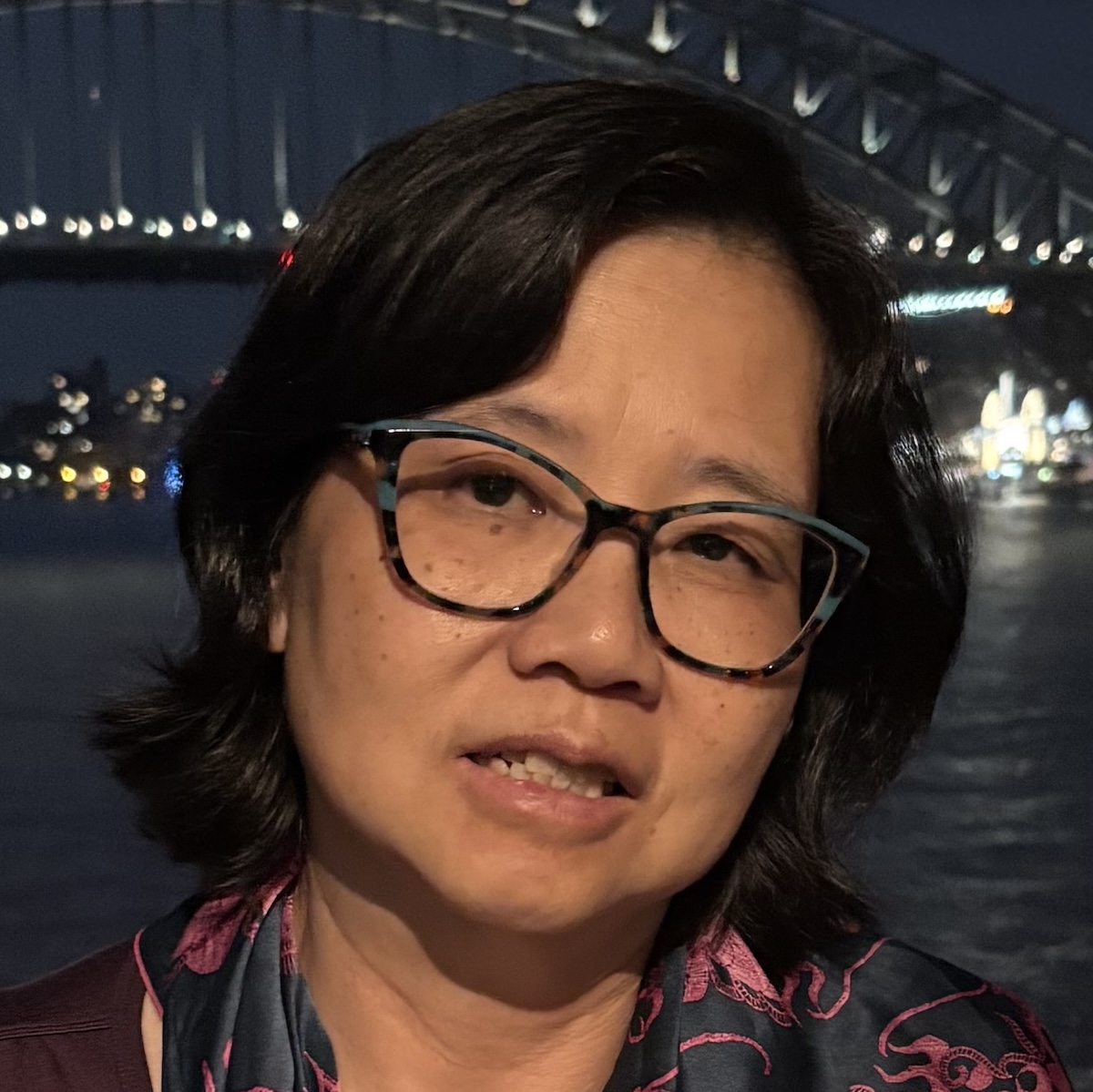
Janaline Oh
Janaline is a former diplomat and current climate, environment and anti-racism activist.
“As a longstanding Canberra-based bureaucrat, I believe in the power of policy to shape and improve lives. I am also acutely aware of the importance of having those policies understood by the people affected by them.
“I started Why Can’t They Just? as way of moving beyond slogans and into what policies really are and what they mean for real people.”