Why Is Australia Spending So Much on Defence and Is It Value for Money? [S3-11]
Posted on Wednesday, Nov 4, 2026 | defence, national security, foreign policy, international lawShow Notes
Please leave a comment, particularly if you have your own “Why can’t they just…” question, or email us at whycanttheyjust@gmail.com. We’d love to hear from you.
Find out more about us and how you can support us at https://whycanttheyjust.com.au/, which includes a link to our Patreon site where you can sign up for exclusive content.
Please also feel free to rate and review us, as it does help people to find us.
Music: “Insurrection”
Written by Pierre Chrétien
Performed by the Soul Jazz Orchestra
Courtesy of Do Right Music Inc.
Transcript
4 November 2026
Glenn
Welcome to another episode of Why Can’t They Just, a podcast about politics, policy and getting stuff done. I’m Glenn Davidson and I’m a member of the Labor Party.
Janaline
I’m Janaline Oh, I’m also a member of the Labor Party. I’m a former diplomat and a climate, environment and anti-racism activist.
Luke
I’m Luke Robertson, a member of the Labor Party, as well as a conservation biology and environmental policy student.
Janaline
Before we start, I‘d like to acknowledge that we are all recording this on the unceded lands of First Nations people in Australia. Recognising that sovereignty was never ceded, we pay our respects to their Elders, past and present, and we extend those respects to any First Nations listeners that we have today.
Glenn
Today we’re talking about defence procurement.
Now, Australia currently spends more than $60 billion annually on defence. Over the next decade, the Albanese Labor government plans to invest hundreds of billions more in new military capabilities, everything from nuclear powered submarines to long range missiles, cyber warfare systems and various autonomous systems.
In fact, we’re about to spend more money on defence capability than at any time since the Second World War. In an uncertain world and fluid security environment, the stakes could not be higher and the task could not be any harder. And experience shows that major projects usually face delays, cost increases and capability challenges.
Then there is the perennial debate about whether Australia should build its own systems or buy proven equipment from overseas, or find a balance between the two. Defence planners are trying to deliver new capabilities faster, strengthen local industry, build a highly skilled workforce and integrate more closely with key allies, all while ensuring value for money. And currently this is all happening against a background of workforce shortages, limitations on industrial capacity and the demands of programs such as AUKUS, made all the more difficult by the populist pressure to cut immigration with the flow-on consequences for the workforce.
Janaline, how does Australia get the military capability that it needs? What’s working, what isn’t, and what needs to change?
Janaline
Those are very big questions, Glenn. Let’s start with procurement.
As you say, one of the features of defence procurement over the years, and not only in Australia, pretty much everywhere, is that, like many big infrastructure projects, defence procurement tends to run over time and over budget.
One of the things that this government has tried to do is rationalise that, so they have set up a new defence procurement agency, specifically tasked with joining the dots of all the different procurement tasks and making sure that things work as efficiently as possible. Probably didn’t help that quite recently there was a news report of how something like $15 million worth of defence contracts had been issued without proper approval. That was then tidied up after the fact. That kind of thing does not improve public confidence in the defence establishment.
I think the government’s response to that has been reasonable: effectively, ‘we are aware that these problems have arisen and that’s why we’re trying to rationalise it through a very specific focus on procurement’.
Pat Conroy, the current minister, has been responsible for that portfolio for quite a long time, including in the last term in opposition. So he is someone who has taken that task very, very seriously in a way that I think other ministers, in comparable positions, have not.
So I think that is one of the reasons that we’re seeing this push to rationalisation and professionalisation of the defence procurement task, because one of the other features of procurement in the past was that it was just another rotation and senior people in charge of procurement would go in there for two to four years, do their job, move on. I think there’s now a recognition that procurement is actually quite a specialised task and that the companies that you’re negotiating with don’t have this rotation of senior negotiators and it’s probably not a bad idea to match their expertise.
Glenn
Yes, that rotation of people through those senior jobs has always been a problem, and you mentioned two to four years, and more often it was much less than that: 12 to 18 months, tick a box and move on.
I also think back, it is good that Pat Conroy has been in that job for several years and has got himself well and truly over it, because there were any number of defence ministers in the previous Coalition government, one of whom made a very helpful comment about not trusting the defence establishment in South Australia to build a canoe, let alone a warship.
All right. So one of the things in terms of the capability that we’re getting, or that we need, or we think we need, is a lot of equipment from the US and greater interoperability with the US so that when we are on joint operations with the US, we can operate seamlessly with them.
Our military people serve on US platforms so that the people know each other, they understand how their systems work, and they can work together. This is going to become even more so with AUKUS.
Janaline, is this the direction we should be going? What’s the upside and what’s the downside?
Janaline
We’ve been integrating with not just the US: the five powers defence pact involves the US, Australia, the UK, Malaysia and Singapore. We’ve been doing joint exercises with those armed forces for decades and I think it’s important to separate three things.
One is the ability of our defence forces to work seamlessly with other like minded defence forces. The second is whose equipment are we using and how is that equipment procured and operated? And the third is who’s making the strategic decisions about whether we engage in particular actions, how we engage and the extent to which Australia is involved, particularly when it comes obviously to armed conflict. They are all quite different things.
In terms of interoperability, I think it is a good thing that we’re trying to be as seamless as possible with people with whom we have fought alongside in the past, and with whom we are likely to fight alongside in the future. Just because we can fight seamlessly with them does not mean that anytime they decide to do something we are going to trail along and follow.
This government has shown pretty definitively that it is not willing to do that. For the first time that I can think of, an Australian government said a hard no to a US president who asked them to get involved in an armed conflict. Donald Trump went out to all of his allies and said: ‘Surprise! I’ve bombed Iran! How would you like to join in and keep open the Straits of Hormuz, because it’s really important to your trade?’
And all of the allies, including Australia, said ‘actually, no’.
The default position for Australian governments up until quite recently has pretty much been if the US trots off to a conflict, Australia will trot off after it. This was true in Korea, it was true in Vietnam, it was true in Afghanistan, it was true in Iraq. We have now demonstrated that there are limits to that, and I think we found the limits.
On the second question of whose kit do we use? To what extent do we try to develop our own capability? What actually are the limitations of our relatively small manufacturing base, research base and our relatively small budget? I mean this is a really hard question.
Small countries have the choice of picking a thing that they can become very, very good at and making that thing or shopping in the global market. We probably need a combination, and I think one of the very under-discussed aspects of the AUKUS agreement is the construction of the submarines on shore, the transfer of a significant amount of military technology from the US and the UK to Australia, and the capability that the government is hoping that will then develop within Australia.
This government is effectively saying we need to build a domestic military industrial complex. I agree with them. I think it is essential to our national security and it is part of reinforcing our sovereign capability.
There is just no way in which Australia can be completely self-sufficient. But if we can build up significant capability in one or more areas of military technology, not only does that give us the ability to use that ourselves, but it also gives us something we can trade with other countries.
So this is not new. For example, we have been part of the F35 fighter jet supply chain run by Lockheed Martin. And the reason this became controversial is because Israel is also part of that supply chain and so therefore some Australian made parts have ended up in Israeli planes that have been used arguably to commit atrocities in Palestine.
But the people who argued we should pull out of that supply chain failed to mention we would lose access to the F35.
So I guess what I’m saying is, these procurement questions are not just questions of where you buy your widgets. These procurement questions go to the heart of who we are as a country, what do we consider to be appropriate types of military technology and what is the cost, both in terms of taxpayers funds but also in terms of the country’s political stance and foreign policy stance towards some of the partners that we are working with?
Glenn
Yes, that’s also true. We’re not dealing in absolutes here and things change over time.
Because these procurement programs go for decades, things change in the political environment in various countries. As you mentioned, Israel has generally been a close ally, and a Western style democracy: the sort of country that we should be dealing with. At the moment, they’re engaged in activities that we don’t agree with.
But we have this structural issue going along underneath, and we don’t need to be in a situation where we’re cutting off our own nose to spite our face on a point of principle. And that’s not a simple matter to resolve.
Janaline
Luke, did you want to say something about the military industrial complex?
Luke
Let me first go on the bit you just had about interoperability.
When US submarines sunk Iranian vessels, there were Australian defence personnel in the submarines and the ADF put out a statement saying that they weren’t involved in anything. They were told to, like, go to their cabins. But even if they didn’t have anything to do with it, the fact that they were there is still a source of discomfort for me, that they would be involved in it. There’s certainly a difference between exercises that we do with all sorts of nations, but having that training and actually being there when there’s stuff happening; I don’t know. That just seems a little bit different to me.
On procurement, I think that’s a really good question about do we want to be building our own military industrial complex. And as scary as that is, I think the answer is yes, particularly given that we can reap the benefits from it because it is much better that we build the things here than buy them overseas because that means the benefits go to the people who are building them, right? That’s a whole lot of jobs that we can have here. I mean, that’s so obvious, right?
You’re certainly right. There is that risk that whenever we are involved in that manufacturing, that the way in which those weapons get sold and where they end up, and the way in which they’re used, is certainly a source of contention. Like you just mentioned with the F35 supply chain where the government says that, ‘oh, we don’t ship them straight to Israel, they go straight to Lockheed Martin and then we don’t know what happens with them’. That’s still the same thing to me, even though it’s slightly removed from it.
But yeah, there’s some good questions and I don’t quite know the answer to them.
Janaline
I think they’re really good points, Luke.
I think the point about improving manufacturing capability in Australia is actually not a trivial one, although, as we have discussed in our conversations about migration, if some political parties get power and throw everybody out of the country, we will not have the workforce to do that.
On the question of the ADF personnel on US subs, that to me is actually confirmation that ADF personnel are always subject to Australian command and they didn’t get involved even though they were embedded on a US sub.
So I think that just underlines the point that interoperability - which had them on the subs - is very, very different from command and control - which had them sitting out the actual conflict.
Again, on the F35, I’m just saying the debate needs to be around whether we are willing to give up our best fighter jet in order to avoid sending any military kit to Israel. And I have to say, obnoxious though I find the Netanyahu government’s actions in Palestine, if I were advising the government, I would prioritise the defence of Australians. I think those who say we should pull out of the F35 supply chain need to explain how we would fill that capability gap.
Now I’m sure there will be people who would take a different view, but it’s not the same question as just saying we need to shut off this supply chain. We need to consider what the implications are for our national defence.
Glenn
Yes, this really is a big and complex issue and it’s quite interesting to consider the moral and ethical challenges raised by you, Luke, there with the hard practical reality of being involved in a tough business.
Now, given the long lead times and the complex and rapidly changing security environment, getting the right equipment is always going to be challenging. Traditionally our defence capability has been made up broadly of personnel, ships, aircraft and weapons. But today’s military capability is far more complex and ranges across various domains and technologies, everything from nuclear powered submarines and next generation warships to long range missiles, cyber capabilities, autonomous systems and advanced surveillance networks. And this is all happening at pace and scale and is aimed at preparing Australia for a far more contested strategic environment. Now, central to that effort is AUKUS, as well as modernising the navy surface fleet, expanding missile capabilities and accelerating the adoption of emerging technologies.
But it is also so much more than that. And as you’ve mentioned, these are not just military projects, they’re also major industrial, economic and workforce challenges. Every new capability raises questions about cost, delivery, local manufacturing, strategic priorities and whether the technology will still be relevant by the time it enters service, often decades down the line.
So Janaline, Australia’s defence capability is not something separate from the rest of the country. It’s driven and shaped by what we are as a country, both what we can do ourselves and what we want to be. Why is it essential that we get this right?
Janaline
I think it’s fairly self-evident why it’s essential we get it right: because there are colossal, eye-watering amounts of taxpayer funds going into these projects. And I think it is really important that we do finance the defence of Australia, particularly in an environment where clearly we cannot rely as heavily as we have in the past on our major allies: firstly because we have a US president who has openly questioned the value of the US engaging in defence of its allies; and secondly because we have a US president who is making decisions around US involvement in armed conflicts that I don’t think Australia wants to have anything to do with, and the current Australian government has made pretty clear it doesn’t want to have anything to do with.
So all of this points to the need to increase our own defence capability. And as I said, I think it’s really important to separate the question of who decides when and on what terms Australia engages in armed conflict, and where we get our kit, how we operate it and whom we work with when we’re doing that.
So I agree with Luke, developing more sovereign capability is really important for the reasons that you guys have already articulated, around also the economic and technological and technical capacity benefits. I mean, let’s not forget that throughout history, military technology has been on the leading edge of a lot of technological development that has subsequently been very, very useful: exhibit one, the Internet.
One of the features of military technology, as well, is that it develops much more quickly than legal systems and ethical systems, and the philosophical underpinnings of how you use this technology, and what is its impact on human beings, can develop. And this has been true since the battering ram started to destroy walled cities, and fiery projectiles from catapults started creating mass devastation of civilians.
The glaring example of the horrific effects of military technology on a civilian population happened in Hiroshima and Nagasaki in 1945, and the world is still grappling with the ethical fallout of that.
In looking at how we develop technology, what we’re developing, and in talking in the somewhat breathless and excited tones of some of our politicians and military leaders, I think it’s also important to bear in mind that the purpose of these things is to be used on other humans. And I think it is really, really important to make sure that the ethical underpinnings and the philosophical work of the Australian Defence Forces also continues at a similar pace.
And I’ve got to say, I think the Australian military is actually pretty good. I have worked with ADF lawyers on rules of engagement in advance of Australia following the US into Iraq, and they are pretty rigorous and they think deeply about the impact of what they are proposing on other humans and particularly on civilian populations.
So in the excitement over defence procurement and becoming a military industrial power, we need to just keep the humans in our sight.
Glenn
That does come down to that question as to whether the weapons are actually working for you without even being fired: just having them and that capability is enough, and hopefully you never need to use them, certainly not on civilian populations. And in one way, since the Second World War, that’s really what’s been the situation with nuclear weapons. You know, that they’ve been there, and the fact that they’re there has prevented rogue states from using them, because they know by using them against somebody else, they’re using them against themselves, and everybody loses.
Luke, there’s a few good moral questions there. I think we need to hear from you.
Luke
Yeah, drones. That’s certainly been a topic of discussion for a while as well. And all those autonomous systems, like actions of the Obama administration in Afghanistan with drone strikes.
And we’re seeing in Ukraine the impact of drone warfare and how it can be quite indiscriminate when there aren’t appropriate rules of engagement within them. And with the drones that are being launched from Iran, that are being launched into, like, hotels and all sorts of civilian infrastructures.
You’re right: the point you made earlier about how the technology advances before we can decide what to do with it as a global society is a good point.
With autonomous vehicles, I can see from a strategic point of view, that’s a great thing. And we can probably assume in Australia that a human would be controlling that. So in that context, I don’t see it being so problematic.
I don’t know if you guys remember the footage of the attack helicopters that were leaked from WikiLeaks, where the Americans were, like, laughing and just shooting civilians on the ground. It was quite, quite damning.
Some big moral questions in there, which again I don’t have the answer to.
Janaline
That’s a very good point you made about those attack helicopters. I mean, I think that really demonstrates the importance of proper rules of engagement and a proper military culture, firmly grounded in the idea that what you are doing is protecting your people against a threat.
This should not ever turn into some sort of game where the lives of the enemy are so devalued that you cease to see them as human. People by and large are uncomfortable committing atrocities against another human being, unless they can be persuaded that that human is not really human.
I think in terms of drone systems, I agree with you, Luke, I think having a human ultimately responsible is absolutely essential. And it was interesting to me that Anthropic, you know, one of the big AI companies, explicitly insisted their systems were never to be used by autonomous weapons to make life and death decisions. I think that was an important ethical stand to make because I think with the advent of AI, it is really important to have human accountability.
And the last thing I’d say is that those people who think that, for example, replacing the AUKUS submarines with a bunch of autonomous drones, is somehow a better ethical choice are grossly mistaken.
The ethics around drone warfare are very problematic to me. Now in Ukraine, the use of drones has clearly enabled a much, much smaller and weaker military force to hold its ground and to defend its country. I think it has been an amazing use of technology to even up the odds in a very, very unequal contest and is the reason that there is a Ukraine today.
That said, the use of drones by the US in Afghanistan under the Obama administration was quite problematic. They were using drones to target people that they thought were high ranking military targets. They often got it wrong. And there was a heartbreaking example of a wedding that was bombed by US drones that killed 200 people because they made a mistake.
And the thing that I actually find most troubling is that the drone operator, unlike the pilots who dropped the nuclear bombs on Hiroshima and Nagasaki, were not even there. They were in the United States. And after dropping that bomb on 200 people at a wedding, then was able to go home and have dinner with their family. I think that is a hugely problematic thing.
One of the things about developments in military technology is that you’ve gone from a situation where you had to look the person you were killing in the eyes as you killed them, and hear them, and engage with them at a very human level, to a situation where you can kill 200 people and then just go home and have dinner.
Glenn
Yes, the imagery of that is really quite confronting. I remember that at the time, and there being the comment that somebody could do that and then go home and take their kid to soccer training as though nothing had happened. It’s just - it’s not right.
So even at the scale and pace and diversity of the projects that we’ve spoken about, it does still beg the question as to whether we can ever have enough, be big enough or strong enough to meet the challenges of much larger and more capable potential adversaries. Countries like the United States, China, India and the UK have large populations, extensive industrial bases and in some cases vast forces and stockpiles that have been built over generations.
Australia’s in a very different situation. We occupy a continent with a relatively small population: our task is to secure one of the world’s largest maritime domains and protect trade routes that are vital to our economy. In that vein, geography has always been both our greatest advantage and our greatest vulnerability. Distance provides a degree of protection, but it also means that any projection of force by Australia needs to operate across enormous stretches of ocean, often far from support and supply. It’s a 21st century take on the tyranny of distance.
Every new capability is expensive, yet the strategic environment keeps changing and the list of potential requirements seems to grow faster than the resources available to meet them.
Janaline, can a country of Australia’s size ever possess all the military capability it might need? Or is the real challenge deciding which capabilities are consistent with our values as a nation, which ones matter the most, which risk we’re willing to accept, and how much we can rely on allies to fill the gaps?
Janaline
Yeah, I think all of those things.
Let’s take the capability question: no we can’t. We just cannot have sovereign self-sufficiency in military capability. As you say, it’s not just about defence of the Australian mainland. Recent commentary and books about so-called porcupine strategies, completely miss the point, because they are based on the false premise that the biggest threat to Australia is a military invasion of the Australian mainland and I think that is utterly wrong. I think as you say, the thing that we really have to defend is our trade routes, our maritime routes are very, very important.
The other thing we have to defend is our values and our democracy, and those things are also under threat by hostile foreign actors, and they do it through cyber attacks and they do it through foreign influence operations, and they do it through seeding divisiveness and dissent within the population. All of these things are not new. People have been doing this for centuries because that weakens the government.
I think, as you say, we do need to rely on allies. The really important new phenomenon in the last few years is the realisation that some of our biggest allies are perhaps not as reliable as they used to be. And it has been incredibly important to generate more of those alliances with other countries, particularly within our region. And we’ve seen the conclusion of security treaties with several Pacific Island countries, with Southeast Asian countries. We’ve seen a strategic conversation open with India, much deeper strategic engagement with North Asian countries like Korea and Japan. We’ve seen the opening of such conversations with the European Union in a way that we haven’t had before. And I think all of this is incredibly important and incredibly useful to us because, again, one of the things that the current US administration seems to have failed to learn out of US history is that it is the US’s network of alliances that has actually kept it safe for the last 80 years.
For Australia, given that we don’t have a particularly powerful military, it’s all the more important to ensure that we have a range of friends.
Luke
That’s a good point about having all those different friends. On Glenn’s broader question, though, about whether we should have more friends or build more things, it’s a very complicated question, but certainly not binary. The truth of the matter is that we do need friends to fill our defence gaps and that is just how it is.
But also it should be how it is. I don’t think the country should be spending exorbitant amounts on defence when it could be just as well served by maintaining healthy diplomatic relationships with other countries. Like, that’s a lot cheaper.
Glenn
Where’s that sweet spot that provides for the defence of Australia, the protection of our interests at a price point and equipment level and ethical context that works for us as a country?
Janaline
Yeah. And I think honestly, you’ve just pinpointed exactly the policy issue that the government is grappling with. They are asking exactly that question, and I think one of the reasons that they’ve stood up this new defence procurement process is to try to make sure that they control the price point. I think one of the reasons that they’re leaning into this development of Australia’s military industrial capability is precisely to deal with the question of how do we ensure that we have enough sovereign manufacturing to enable us to maintain a strong sovereign capability, which, as I said, also involves having stuff that you can sell to other countries.
And finally, the colossal diplomatic effort that they’re putting in with regional partners, and partners well beyond our region, to enhance and develop those friendships, I think is exactly to ensure that we have options. And that if it does come to the defence of Australia, we will have friends who will come to our defence, even if they’re not necessarily the friends that we had relied on always in the past.
Glenn
Now that’s been a huge conversation where we’ve raised a whole lot of issues across the economy, across ethics, across values, across defence, across international relations, the state of the world, the behaviour of allies. It’s a huge area. It’s not just a matter of spending money to buy the latest widgets.
But our time is coming to an end and it’s time to have our final comments. And we’ll start with you, Luke.
Luke
It is a ginormous, wicked problem. This discussion has been very wide ranging and every single one of the points of discussion we’ve had, I haven’t really come to a conclusion, at least in myself.
So yeah, it’s complicated. But definitely the things I’ve come away with is definitely developing our own capabilities is incredibly important, along with the fact that the government can own the company which will produce the weapons and therefore having control over it. And when we export that technology, we reap the benefits from it.
But definitely some big challenges. I thought of, when we were having the drone discussion, I wonder if they were having the same thing when, like, artillery was first invented, what they thought.
It’s a wicked problem, but I’m pleased in the direction it’s going, mostly. I would say I’m a huge fan of the Defence Delivery Agency and I think it’s a great idea.
Glenn
Thank you, Luke, and from you, Janaline.
Janaline
I am so happy you raised diplomacy, Luke, because I think one of the massively under-discussed parts of our national security and defence strategy is actually diplomacy. OK, maybe I would say this because I was a diplomat for most of my life so there is probably a degree of self-interest in this. But I think it was one of the US Joint Chiefs of Staff who said ‘the more you invest in diplomacy, the less I need to invest in ammunition’.
And it comes back to the Art of War, Sun Zi, an ancient Chinese general, who said the best strategy for national defence is to make people not want to hurt you. Doesn’t mean going around and appeasing people who are behaving obnoxiously. So I don’t think Ukraine capitulating to Russia would have stopped Russia from hurting it. I don’t think the Allies deciding it was OK for Hitler to take Austria would have stopped Hitler from harming other countries in Europe, not to mention Austria.
But I do think that diplomacy is massively underrated.
And I’ve got to say, under recent Australian governments which focused enormously on military hardware and which underfunded the diplomatic service and diplomatic activity, there was a real imbalance in there that I think this government has, to its great credit, significantly redressed.
The realisation that diplomats are actually at the very front line of national defence is a really, really important concept because well, before you actually need to use any of your things that go bang, you really need to be deploying the people who can talk other people out of lobbing things that go bang in your direction.
And when you get to the point where you do find yourself in a conflict, if you don’t have a diplomatic solution, if you do not have a political solution, you are never going to have a lasting peace. In the First World War, the Allies thought that the obliteration of Germany’s military capacity would get them a lasting peace. Within a generation, they had Adolf Hitler and the Second World War. I think we need to learn the lessons of history.
And the nature of warfare is changing quite dramatically and quite fast. Military technology has advanced in various stages in the past, going back to bronze tip spears and catapults. But the pace of change now is quite dramatic.
And the other thing that has changed is: what actually is a hostile act of war, because in the past that tended to involve things that went bang. And now, we saw recently an Iranian state actor hack into US water supply systems and turn off the filtration. That had the capacity to cause enormous harm to very large numbers of American citizens, on American soil, very, very, very far away from Iran. Was that an act of war? I would argue it was. Now, in this case, Iran is actually at war with the US, so maybe you would consider that to be a legitimate act under the laws of war. Having said that, it was attacking a civilian population, which is not legitimate under the laws of war unless it’s subject to a whole lot of rules around proportionality.
It did, however, expose the extreme vulnerability of the United States water supply systems to this kind of attack. Apparently some of those systems weren’t even password protected. So I’m hoping that that has generated a whole lot of activity in the US to actually protect these things. I hope it’s generating activity all around the world, including in Australia, on whether our systems are properly protected and whether we have, you know, robust passwords protecting our water supplies.
The Russians are strongly suspected of trying to blow up civilian aircraft in Leipzig, in the heart of Germany, with drones. That attack didn’t take place. It was thwarted.
Was that an act of war? It’s hard to say. One of the things that the NATO allies - NATO being the North Atlantic Treaty Organisation - one of the things the NATO allies are dealing with right now is: at what level do Russian hostile acts against their members take them to the level of triggering the mutual defence pact? If Russia sent tanks into Latvia, that would be pretty clear. But Russia’s not sending tanks into Latvia. They’re planting drones at Leipzig airport.
All of these things demonstrate the complexity of the decisions around military action. What even is a military act? What even is a thing that triggers a national defence response?
These are really difficult questions and all countries need to grapple with them. Those questions that you posed, Glenn, are absolutely at the heart of what every government should be looking at, in terms of making those decisions about how much they need to invest, what they need to invest in, the extent to which they need to rely on other countries to help them, are absolutely critical.
But underlying all of this has to be an acknowledgement that national defence is not things that go bang; that the things that go bang are the tiniest part of your national defence strategy. And in the modern world, your national defence strategy includes your cyber capabilities, it includes cyber defence, it includes community cohesion. All of these things are so important.
I think government decisions around military spending and defence procurement need to be placed in the context of the whole of what is national security, including procurement, including the operations of defence, including our alliances and including diplomacy.
Glenn
That was another episode of Why Can’t They Just? The theme music that we use for this podcast is a piece called Insurrection by Pierre Chrétien, performed by the Soul Jazz Orchestra, courtesy of Do Right Music Inc.
Janaline
You can also hear us on Canberra community radio, 2XX FM 98.3, on Tuesdays between 6 and 7, or via 2XXfm.org.au. If you like our work, consider supporting us on Patreon, via our website whycanttheyjust.com.au.
Glenn
I’m Glenn Davidson.
Luke
I’m Luke Robertson.
Janaline
I’m Janaline Oh, and this is Why Can’t They Just?
Hosts
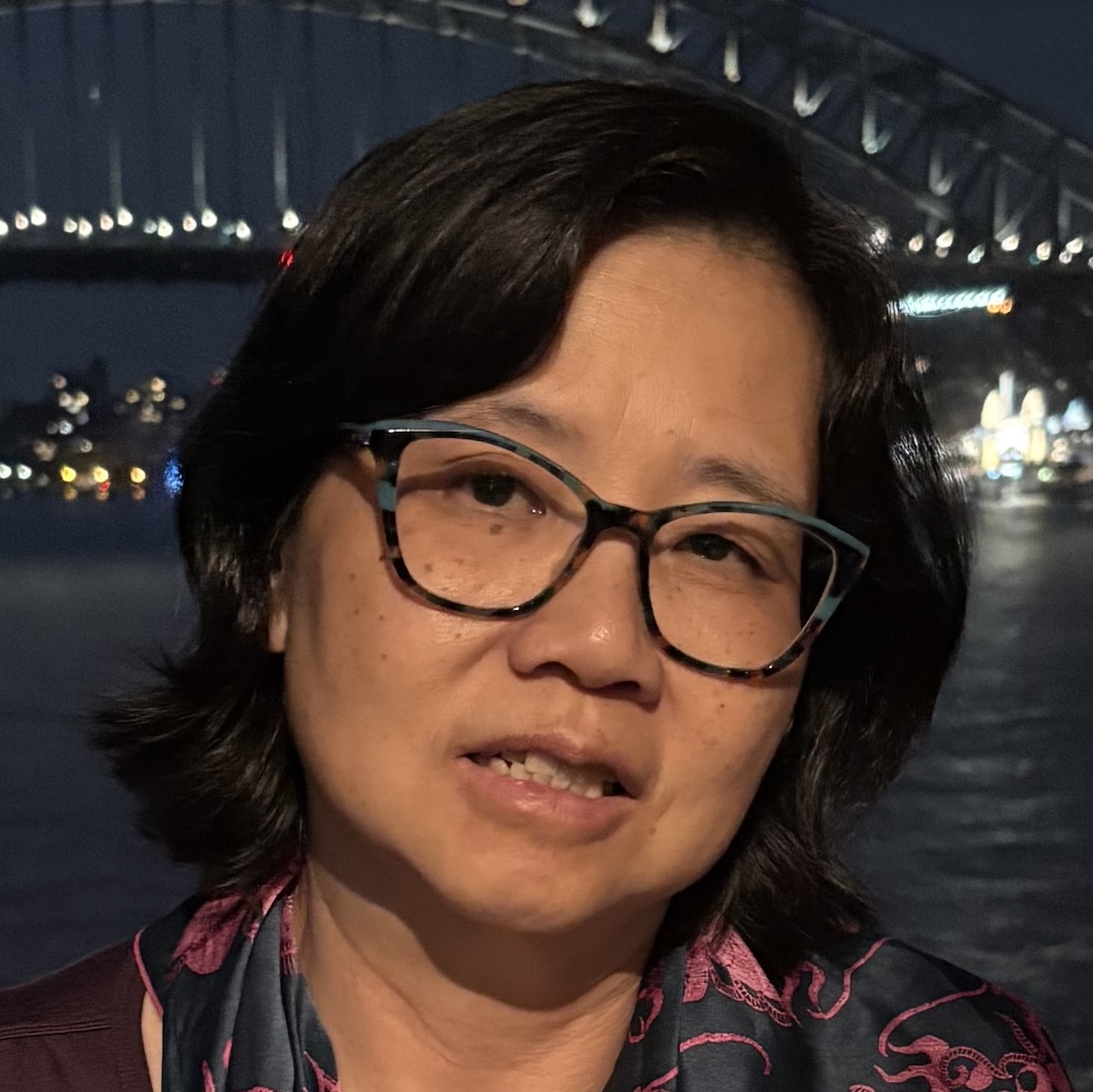
Janaline Oh
Janaline is a former diplomat and current climate, environment and anti-racism activist.
“As a longstanding Canberra-based bureaucrat, I believe in the power of policy to shape and improve lives. I am also acutely aware of the importance of having those policies understood by the people affected by them.
“I started Why Can’t They Just? as way of moving beyond slogans and into what policies really are and what they mean for real people.”

Luke Robertson
Luke is a student in conservation biology and environmental policy.
“I got interested in public policy and particularly environmental policy around 2020, seeing the damage that things like the ‘Wild Horse Heritage Bill’ did to Kosciuszko National Park, as well as budget cuts made to the national parks service that eventually worsened the Black Summer Bushfires.
“I joined the Policy for People and Why Can’t they Just team after seeing the hard fought passage of the Environment Protection and Biodiversity Conservation Act and the power of community organising for good. I am now hoping to help with community outreach in all areas of policy to make Australia the fairest and most equitable country that it can be.”

Glenn Davidson
Glenn has a background in education, public service and community radio.
“After far too long being annoyed about the confected outrage, gaslighting, punching down and wilful distortion of facts in our national discourse, I jumped at the opportunity to join the team at Policy 4 People and Why Can’t They Just. I hope to contribute something positive to ordinary people like me understanding complex issues and exercising their vote in an informed way to build and sustain a community and nation that works for all of us.”