Australia's New Hate Speech Laws [S1-13]
Posted on Monday, Feb 9, 2026 | social policy, social cohesion, human rights, free speech, democracyShow Notes
Please leave a comment, particularly if you have your own “Why can’t they just…” question, or email us at whycanttheyjust@gmail.com. We’d love to hear from you.
Please also feel free to rate and review us, as it does help people to find us.
Music: “Insurrection”
Written by Pierre Chrétien
Performed by the Soul Jazz Orchestra
Courtesy of Do Right Music Inc.
Transcript
William Sinclair
Welcome to Why Can’t They Just, looking at politics, policy and getting stuff done. My name is William Sinclair and I’m a member of the Labor Party.
Janaline Oh
My name’s Janaline Oh. I’m also a member of the Labor Party. I would like to acknowledge that William and I are both recording this on unceded lands of First Nations people in Australia. We’d like to extend our respects to their elders past and present and also any First Nations listeners that we have.
William Sinclair
Today’s episode is being recorded on the 1st of February in the wake of Australia’s new hate speech laws passed in the Parliament. The hate speech laws constitute a new legal definition of a hate group, which is any group that is engaged in, assisted or advocated engaging in conduct, constituting a hate crime other than advocacy offences.
A broad definition of a hate crime is any crime motivated by a person because of their political opinion, national or ethnic origin, nationality, and a slew of other sort of identifiers. More importantly, a person does not need to be convicted of a hate crime for the Minister to be satisfied that an organisation is engaged in the conduct mentioned. The other provision which failed to get through the Parliament was the racial vilification part of the bill, which was going to criminalise publicly promoting or inciting hatred.
As far as I can tell, the racial vilification law, which publicly promoted or incited hatred, would criminalise a range of political opinions expressed particularly in the United States and to a lesser extent in Australia. So for example, Pauline Hanson’s quote, we’re in danger of being swamped by Asians, to me sounds like promoting or in hatred against an ethnic group. Or, this is where Pauline Hanson is quoting a Labor leader in her maiden speech. “Japan, India, Burma, Ceylon and every new African nation are fiercely anti-white and anti one another. Do we want or need any of these people here?”
It would seem to me that this law would basically make the One Nation - a sort of very popular minor party at the moment - their ideology or rhetoric, illegal. The other thing that I think is just absolutely bonkers is the fact that it would make the leader of our closest geopolitical ally, the United States, also illegal.
So when Donald Trump says, quote, “when Mexico sends its people, they’re not sending their best, they’re bringing drugs, they’re bringing crime, they’re rapists, and some, I assume, are good people”. That sounds like promoting hatred against an ethnic group. So, it would seem odd to me that we would make the rhetoric, ideology and behaviour of the leader of our closest geopolitical ally basically illegal. Janaline, what do you think?
Janaline Oh
Yeah, look, I mean, I don’t think Donald Trump is going to be affected by this law. Pauline Hanson, another issue. Yeah, I agree with you. A lot of the things that she says could arguably be regarded as promoting hatred. And definitely her party, the National Party, and in fact every other party in the Parliament objected to the racial vilification part of the laws, which is why they were dropped. The Government has not pursued that part of the laws.
In terms of the hate speech laws as a whole, I mean, what they basically do is they essentially lower the threshold for criminalization of things that are already criminal. So it is already a criminal offense for a group to incite violence or to promote terrorism. So one of the things that the Government explicitly wanted to do with these laws was to lower that threshold because they were arguing that a lot of people and groups were deliberately couching their speech in a way that fell just below that threshold. So they’re inciting hatred without going the extra step of actively inciting violence.
Now, the political context of these laws is that the Government put them in place, recalled Parliament a little bit earlier, under enormous pressure from the Opposition, which then complained that it was all being too rushed, the media, and large parts of the Australian community, because after the Bondi terrorist attacks, people were, as they always do after these awful events, saying, “you gotta do something. What is the Government doing? The Government has to do something”.
Now, is what they did the right thing to do? I have to say, personally, I tend to take the view that banning groups and banning speech generally is not the best way to eradicate the sentiments that underlie those groups and that speech. Banning neo-Nazis is not going to make the people who were part of those groups suddenly say, “oh, yeah, I think you’re right. We shouldn’t be following that kind of ideology. Actually, we should just be very nice to all people, regardless of their colour”.
I don’t think that’s going to happen. And banning the group runs the risk that instead of forming in a public way, where you can see what they’re doing and you can see where they are, they will just go underground and be much harder to track.
So I guess I tend to take the kind of small L liberal view that the best way to deal with hateful speech is to have more speech, is to have debates, to actually expose it, to rebut it, to engage with it, and to engage with the people who are expressing it. Because even if you can’t persuade those people to change their views, at least you can make clear to people around them who might have been attracted to those views as to why those views are damaging or bad or, you know, harmful to people.
So that is my personal approach, so I would have to say, I would not have done this, if I were the Government. But having said that, I also understand that after the worst terrorist attack on Australian soil, there is a massive call for the Government to do something and to pass some sort of legislation. I wish that they would stand up and say, you cannot legislate away this thing.
You know what I really would have liked the Government’s response to this to have been, is to stand up and say, you know what? We are going to have another look at the National Anti-racism Framework that the Race Discrimination Commissioner issued two years ago, and that we haven’t yet responded to. Because within that framework are a whole lot of really practical recommendations on how to actually deal with the underlying problems of racism, of which, you know, I would say anti-semitism is a part.
And you would actually have the tools not just to ban the speech, which is the symptom of these horrible attitudes, but actually to start addressing the attitudes themselves. And I think that is a much more constructive way.
The other thing that I really wish the Prime Minister had done, or rather not done, is stood up and said, because of these laws, you know, we can ensure that an attack like Bondi will never happen again. That is just not true. They cannot control that. The people who perpetrated, or the alleged perpetrators of the attack in Bondi recently, were a father and son who were acting alone, who had no known links to any groups. They were not part of some sort of IS cell.
You cannot police every single person in Australia unless you want to become a totalitarian state. And I don’t think Australian people would welcome that. And I also think that they would strongly oppose the kind of budgetary investment that is actually required to deliver a totalitarian state. If you look at what the Chinese Communist Party spends on domestic surveillance and domestic security, I can’t see the Australian people putting up with that kind of weight in the budget.
I think it would have been a lot wiser for the Prime Minister to stand up and say, this was a deplorable attack. We really need to look at the underlying attitudes that may have driven these people to make, you know, to do this terrible thing. But we also have to be honest that we cannot police away bad attitudes.
That said, I don’t think the actual content of the hate speech laws is devastatingly bad. I don’t think that a lot of the criticisms that I’ve heard from the Greens, from David Pocock who voted against them, that they only protect one community - I don’t see that in the laws. I assume they’re talking about the title of the Bill, which refers specifically to anti-semitism, but there is nothing in the content that protects only one community. It’s very clear that these laws apply to hatred against any community. And I would add that shortly after the laws were passed, the first visa that was cancelled on grounds of promoting hatred was a right-wing Jewish influencer who had celebrated the death of children in Gaza. I just don’t see the basis of those criticisms.
William Sinclair
My concern with this law is the way it strips away the separation of powers when it comes to prosecuting people. So for example, the Minister has to be satisfied on reasonable grounds that the organisation proposed to be banned has engaged in assisted, planned or advocating conduct that is a hate crime. And what is a hate crime? Not only does it include Commonwealth offences, but State offences too.
The important part is that no conviction for a hate crime is required for the Minister to take into account conduct before the law came into force. And the most troubling aspect is that the Minister does not have to accord procedural fairness to the organisation of which he or she proposes to ban.
So this law smacks of absolute contempt for the separation of powers, the idea that the judiciary is going to look over what the executive government is going to do, and be a sort of independent oversight. All that’s sort of stripped away.
Now we have a situation where if the AFP and the Minister decide that you’re a hate group, then away you go, everyone goes to gaol. And the law only steps in to just prove that you were part of a group and then you’re off to gaol.
It is very unclear whether or not you run afoul of these laws. So for example, Michelle Rowland went on 7.30 the other day and David Speers basically asked her if calling the situation in Gaza genocide or saying Zionism is wrong or being anti-Zionist, if these would all run afoul of these new laws. And Michelle Rowland basically ducks the questions. It’s all kind of as vague as it seemingly is unfair. And those are my sort of principal problems: the vagueness, it’s not clear, and there’s very little oversight in terms of actually applying the laws.
Janaline Oh
Yeah, so look, I think definitely there is overreach in the laws. I’m not going to, I’m not going to say there isn’t. I don’t think it is as catastrophic as you put it, partly because there is also a provision in all of these new provisions, they are all subject to a review after two years to see how they’re working, if they have been applied reasonably.
You know, it sort of brings to my mind some laws that were passed in the early 2000s, allowing for preventative detention for people that, you know, that ASIO thought might be thinking about planning a terrorist attack. They were very vague. There was, there was actually, it was actually worse than this because there was no transparency either. You could be taken into preventative detention and nobody would know. Those laws have only ever been used twice in the last 20 years. I think the agencies have been quite responsible about the way in which they’ve applied them.
Now I am not saying that it’s fine to have all sorts of overreach in your legal system and just hope that agencies are responsible. I think we’ve had plenty of examples, both here and internationally, of where law enforcement agencies in particular have abused their powers. So, you know, I’m not saying that that’s fine.
I think we, I think we should hold the outrage. I mean, one of the reasons that you don’t have to have been convicted of a hate crime is because some of the crimes that are now considered to be hate crimes were not hate crimes before this law was passed. So it is retrospective in that respect. It also has to compensate for the fact that the racial vilification part of the laws was dropped, so there was a slightly cleaner version previously that said, if you were convicted of an offence like racial vilification, then that would be a basis for designation as a hate group. And that’s where obviously your judicial oversight comes in.
I think it is problematic that the Minister doesn’t have to accord procedural fairness to a group. As I said, I think just banning groups actually, generally, is not going to help. That said, there are groups that do openly espouse hate, that are organising with a view to try to harm other people. I do think that this is a thing that governments have to take seriously.
I would agree with you that I think there should be more oversight and I’m hoping that, in a couple of years, when we’ve seen how the laws have been applied, that more oversight will be introduced.
Michelle Rowland cannot say in the media this action is going to be proscribed and this action is not. Everything depends on the intent of the action. If you are saying Zionists are terrorists with a view to making people hate Zionists because you think they’re complicit in genocide, then maybe that is hateful, because maybe many of the people that you have captured in that, in fact, I would say all of the people that you capture in that in Australia are not actually complicit in genocide, regardless of what they think of what is happening in Palestine.
But if you are talking about Zionism and you are having a debate and you are talking about the historical effects of the Zionist movement, that’s not hateful.
William Sinclair
So what about this as an example. Let’s say that you are inciting hatred against Nazis, and you say all Nazis are terrorists and I hate them. Would that mean that you run afoul of these laws?
Janaline Oh
If I am organising a group with the view, with the purpose of inciting hatred towards Nazis in a way that causes them actual harm, then maybe I would fall foul of these laws. It’s about, are you doing this with a view to harming people? If you are making your views known about a foreign policy issue overseas, like the devastation in Gaza, and you are expressing views about Israel’s conduct, and you are expressing views about the Zionist project in that context, I don’t think that is hateful. But if you are doing that with a view to getting people to go and harass Jewish people for wearing a skull cap or a Star of David, if you are - if you are menacing Jewish children on their way to school, then I would say that is probably hateful. If you are organising a group to go and rip hijabs off Muslim women in shopping centers, I think that’s hateful.
Okay, this is about groups, but we’re also talking about hate crimes. So it is a criminal offence now to be inciting hatred against a group, and they’ve lowered the threshold from in a way that a reasonable person would consider to be incitement of hatred to the way that a reasonable, a reasonable person from the target group would view it. I don’t think that was necessary. And I can see the reason for that motivation, but I also feel that that is a pretty wobbly threshold.
I guess what I’m saying is, would I have drafted these laws in this way? I don’t think so. Do I think that banning hate speech stops people from feeling hate? No, I don’t. And in fact, in some ways, it can be counterproductive. The more people feel like you’re suppressing their views, the more attached they are going to be to those views.
I still maintain that the best way of dealing with hateful views is to rebut them publicly, to make the case against them.
William Sinclair
Yeah, I would agree with you there. I suppose the way in which I think it could be most open to abuse is: some members of a group, let’s say there’s a group that’s doing a political thing, pro-Palestine or One Nation, whatever you want, some members of that group go out and do some hate crimes. And then the police and the guys from ASIO come in and say, Oh, okay, well, some members committed some hate crimes, there for the whole group is a hate group, and then everyone goes to gaol.
Janaline Oh
I mean, I take your point. If a couple of members of the group do something hateful, I think what is important then is how the rest of the group responds to that. If a couple of One Nation supporters decide to start assaulting women in hijabs, then, if Pauline Hanson and the leadership of One Nation say, good on them, that’s exactly what they should do, then maybe they should be proscribed as a hate group. If on the other hand, they say, no, we absolutely disavow that kind of behaviour, we have views on immigration, but we don’t condone violence against women with hijabs then that, and they expel those members, then that is a completely different thing.
William Sinclair
But that - what you’re talking about there is not written in the legislation. What matters is what the Minister thinks and what the AFP’s recommendation is. There’s no, there’s nothing in the legislation that I can see that it depends on what the group as a whole’s response is to a couple of members that determines whether or not they’re a hate group.
Janaline Oh
Well, no. Yeah, okay, but the Minister has to have reasonable grounds to think that the group is a hate group. And the actions of a couple of members that are then disavowed by the rest of the group are not going to be accepted as reasonable grounds. And even though the Minister doesn’t have to accord procedural fairness, there is still the opportunity under the Administrative Decisions Act for judicial review. If a Minister makes a decision and you think that that decision was wrongly made according to the legislation, as in, they didn’t have reasonable grounds, you can challenge that and you can challenge that in court and then the court will adjudicate as to whether the Minister was reasonable. So it’s not true that there is no judicial oversight. There is built-in judicial oversight into every ministerial decision.
There are checks and balances here to ensure that you don’t have the kind of crazy overreach that you are talking about.
William Sinclair
Yeah, I’m not, I don’t think there’s any crazy overreach tomorrow. I think that it’s going to make it easy for crazy overreach, you know, if there’s a right-wing government sometime in the distant future, where they wouldn’t even need to change the legislation. They could just find the legislation that already exists and just say, Oh, well, you know, such and such a group that we don’t like is a hate group.
Janaline Oh
Well, you know what? I mean, the legislation exists. Like even before this lowering of the thresholds. There are provisions in legislation to criminalise groups. I mean, the motorcycle gangs were criminalized. Membership of a motor- and this was hugely controversial, and rightly so, in my view. So if a motorcycle gang was designated a criminal group, then just being a member of that group was enough to make you a criminal, regardless of whether you’ve done anything other than just be a member of that group. Okay. So that legislation has existed for some time.
And I think even right-wing governments in Australia are subject to democratic norms, they are subject to judicial review, they are subject to all of the same things that Labor governments are subject to. So even if you get a political party that is more inclined to be authoritarian, you still have the checks and balances of the Australian system.
And frankly, I know a lot of Liberals who would argue that Labor is a lot more authoritarian. I mean, you know, if you’re talking about which party thinks that the government should have a bigger role in people’s lives, traditionally it hasn’t been the Liberal Party.
William Sinclair
I am concerned about the idea that we’re going to take inciting hatred down to promoting hatred as the bar for sending people to gaol. Inciting hatred means that you are saying something along the lines of, you know, attack, commit violence against that person over there. Promoting hatred is expressing a political opinion.
Janaline Oh
Yeah, and look, I get your difficulty with this, and, as I said, you know, my view is that, if you’ve got a problem with someone’s political opinion, the best way to deal with it is actually to debate it and not to ban it. I would prefer to see the thresholds higher.
But I also think promoting hatred is not nothing. And I say this as a person who has had racial hatred directed towards them. It’s not nothing, right? The reason that we have Section 18C of the Racial Discrimination Act, which says that you can’t say things that cause hurt and offence, which the Liberal Party has tried to eradicate for years on free speech grounds. You know, George Brandis actually said people need to be allowed to be bigots.
Now at one level, yes, I agree with that. At another level, I would have to say that provision has been a shield against some pretty horrible and hurtful things. And I’m thinking of things like, things that Alan Jones has said about various Indigenous leaders. And that has also been on the law books since the 1970s.
From a kind of theoretical, philosophical, supporting free speech provision, I agree with you, you can’t legislate away hate. But I also do think iIt is not unreasonable to protect people from some of the kinds of promotion of hatred that I personally have experienced.
You know, during COVID, where it was pretty difficult to have a Chinese face in some places, like local shops.
I’ve got to say, the people that these laws have protected and are hoping to protect further, you know, also, I think need some sort of protection. Whether this is the right balance, whether this is the right threshold of protection, I don’t know.
William Sinclair
Okay, I’m just going to say this last thing about the Liberal Party. My problem, I mean, I suppose this gets to why I made a podcast, why I encourage everyone to vote Labor, why I think that you should vote Labor even if you have some ideological problems with their Party. Because what Labor is up against, particularly in the Liberal Party, are the most cynical, self-interested people you could imagine. That they would take something like the Bondi massacre and say, how would this benefit me? How do I score political points against Anthony Albanese? How do I infer or imply that he made Australians unsafe or he’s somehow responsible for the Bondi terrorist attack. How cynical can you get to so quickly politicise an Australian tragedy? I suppose my intense dislike of the Liberal Party goes beyond simply the fact that we’re ideologically misaligned, that they believe in sort of capitalism and free markets in a holus bolus kind of way. It gets to these kinds of issues where they immediately jumped to, how do we use this to attack the Prime Minister and score as many political points as possible?
Janaline Oh
Yeah, look, I found that very disappointing as well. I would have hoped that there was an opportunity for the Liberal Party to stand up in solidarity with the Jewish community, with the people of Bondi, and with all Australians to say this was a shocking and terrible thing and we will work constructively with the Government to see if we need to change laws and policies to make this better instead of going to “Anthony Albanese has blood on his hands”.
I would add to that actually that I am also deeply disappointed that Scott Morrison, a former Liberal Prime Minister, then went to Israel and made a speech basically saying this is the fault of Australia’s Muslim community and the Muslim community has to fix it, and the Government needs to fix the Muslim community by registering preachers and vetting sermons.
This is the kind of thing that the Chinese Communist Party does, right? It goes to churches and it registers them and it, you know, your priests have to kind of meet an ideological test in order to practise, and your sermons get vetted. That is not religious freedom and that is not Australia. And also, why does the Muslim community have to take responsibility for two lone wolf individuals who had no particular connections to anybody, who did attend a particular mosque and did listen to particular sermons, but was not in any way part of any kind of push within that mosque to do anything like this. The other members of that mosque are not complicit in their decision to do this terrible thing.
I just find it really disappointing that anytime, frankly, a person from an ethnic minority community, as in a non-white, non-Christian community, does something, the whole community is made responsible for that thing. But when a white Australian Christian goes to New Zealand and murders 51 people in a mosque while they are praying and live streams it, nobody then says it is up to the Australian Christian churches to take responsibility and stop their community members from doing this sort of thing. When a couple of evangelical Christians in Wieambilla, murder police people, nobody says, where are the Christian leaders? Why aren’t they controlling their people?
Okay, as Pat Conroy, the Minister for the Pacific and Defence Industries said when asked, Scott Morrison is a private citizen. He’s entitled to his views and he’s entitled to express them. What I found really disappointing was that Senator Andrew Bragg, who is a front bench member of the Liberal Party, so he is a cabinet, a shadow cabinet member, then got onto Australian National Radio and endorsed those comments and backed them in really strongly and said, yes, I think it is not unreasonable. The Muslim community has to take responsibility.
I find that beyond disappointing. And frankly, I would say to Andrew Bragg, I’m pretty confident he’s not listening to this podcast. But if he were, I would say to him, when he says only one community in Australia is living in cages, as in the Jewish community is living in fear, I would say there are a lot of Muslim women out there who are afraid to go out in their hijabs because they are afraid of being physically attacked.
William Sinclair
The other thing that I hate about this kind of conduct is the level of stupidity. I mean, I guess my points is, who do you think ASIO relies on to thwart terrorist attacks by Muslims? They’re relying on some Muslim guy in a mosque, ringing them up and saying, hey, there’s something dodgy going on.
We are reliant on the Muslim community to help us catch these guys who want to commit terrorism, and the, and the Liberal Party goes out and I don’t think the Liberal Party could piss those sorts of people off more in terms of their rhetoric and conduct. Do you really think, Liberal Party, that your behaviour is going to help ASIO catch these guys?
Janaline Oh
Yeah, yeah, and not just in the Muslim community. So I just want to be very, very clear that there is no suggestion from this podcast that terrorism is an Islamist or a Muslim problem, right? There have been more Christians convicted of terrorist offences in Australia than Muslims.
But you’re right. I think, you know, the law enforcement relies on communities being watchful for this sort of activity within their communities, whether they’re Muslim or Christian or Buddhist, or Sikh. You rely on people basically helping you to identify, you rely on parents alerting the police when they think their children are getting sucked into extremist rabbit holes. And that has happened on a number of occasions in Australia where parents have actually alerted the police and said, my son needs help. Unfortunately, it tends to be boys.
It is members of the community alerting law enforcement to issues that they identify emerging within their own communities and sometimes within their own families that actually helps us to avert these things. You are spot on.
William Sinclair
That concludes this episode of Why Can’t They Just. If you’d like to leave us a comment or send us an e-mail at whycanttheyjust@gmail.com, no apostrophe, or leave a comment on Spotify, we’d love any suggestions and feedback. If you’ve got any ideas for who we should have as a guest on the program, we’d love some suggestions about that, or if we should go on someone else’s program. Any comments or thoughts are appreciated.
My name is William Sinclair.
Janaline Oh
My name’s Janaline Oh, and this is Why Can’t They Just?
Hosts
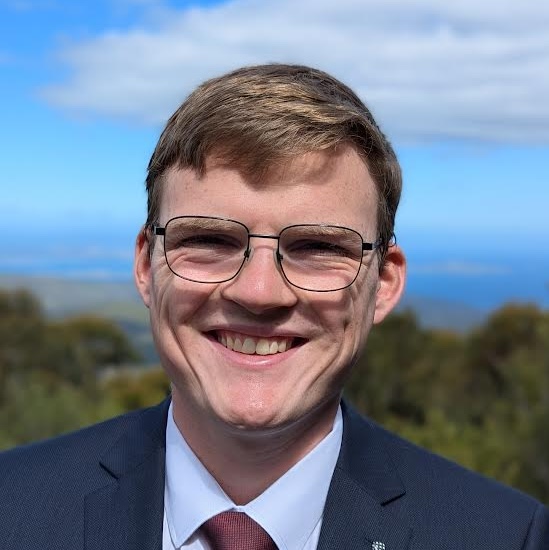
William Sinclair
William is an economist and mathematician.
“People on the progressive end of the political spectrum have legitimate questions: Why can’t they just stop new coal and gas? Why can’t they just end the AUKUS program or stand up to Donald Trump or do all the ambitious things that progressively minded people would support?
“This podcast tries to answer these sorts of questions in a compassionate way without the dismissiveness that often accompanies mainstream politics. We try to examine the other side’s point of view without condescension or contempt. I wanted to make a podcast that would rise above the petty politics of gossip, horserace punditry and psychological conjecture on politicians that passes for analysis. I wanted to talk about the thing that really matters: policy.
“I hope our listeners will hear an argument they genuinely find novel and reach their own conclusions about what we’re discussing.”

Janaline Oh
Janaline is a former diplomat and current climate, environment and anti-racism activist.
“As a longstanding Canberra-based bureaucrat, I believe in the power of policy to shape and improve lives. I am also acutely aware of the importance of having those policies understood by the people affected by them.
“I started Why Can’t They Just? as way of moving beyond slogans and into what policies really are and what they mean for real people.”