US Bilateral Relationship and International Rules-Based Order [S1-12]
Posted on Sunday, Feb 1, 2026 | foreign policy, US alliance, defence, national security, international lawShow Notes
Please leave a comment, particularly if you have your own “Why can’t they just…” question, or email us at whycanttheyjust@gmail.com. We’d love to hear from you.
Please also feel free to rate and review us, as it does help people to find us.
Music: “Insurrection”
Written by Pierre Chrétien
Performed by the Soul Jazz Orchestra
Courtesy of Do Right Music Inc.
Transcript
William Sinclair
Welcome to Why Can’t They Just, looking at politics, policy and getting stuff done. My name is William Sinclair and I’m a member of the Labor Party.
Janaline Oh
My name is Janaline Oh. I’m also a member of the Labor Party. I’d like to acknowledge that William and I are both recording this on the unceded lands of First Nations people in Australia and extend our respects to their elders past and present, and to any First Nations listeners that we have today.
William Sinclair
Today’s episode is being recorded on the 23rd of January 2026. Right now, there’s a big famous meeting going on in Davos where Mark Carney has just made a very powerful speech outlining what he sees as the peeling away of the old international order and advocating for a change in how what he calls middle powers should behave in response to great power politics and bullying. This is obviously in the context of Donald Trump’s desire to acquire Greenland and bullying the Europeans over that.
Janaline, I guess my first question is why can’t the Australian Prime Minister, Anthony Albanese, just be as strong and vociferous in standing up to Donald Trump as the Canadian Prime Minister, Mark Carney?
Janaline Oh
Yeah, that is a very good question. I mean, Canada, like Australia, is part of the Five Eyes intelligence sharing network with the US, New Zealand and the UK. Canada has a long standing, intensely complex bilateral relationship with the US. Their security relationship - they’re both in NATO together and obviously the US is Canada’s biggest trading partner, biggest investment partner. Yeah, there are a lot of reasons that Canada and Australia are similar in terms of their relationship with the US.
Firstly I push back a little bit on the idea that our Prime Minister and particularly our Foreign Minister have not stood up and said some of the things that Mark Carney just recently said at Davos.
So Mark Carney’s basic message was that the old international order was very much underpinned by a benign superpower that essentially used its military power to underwrite the peace and security, the human rights framework, the global trading framework, and that power was the US. The US has clearly indicated it is not interested in playing that role anymore. It is invading countries, it is threatening NATO allies, it has threatened to annex Canada.
His point is that, unless you want to get into a world where you just have raw power dictating what happens, that big, powerful countries with big, powerful militaries can just go and invade anybody that they feel like in order to get hold of their resources or for whatever reason they decide, then it makes the whole world less safe. And he said, especially firstly for the small countries, then for the middle powers, and then ultimately for the great powers themselves.
And the history of the world is about various groups of powerful people acquiring power that enables them to use violence to conquer, subjugate, absorb other people for their resources.
After a couple of very, very terrible wars, firstly in Europe and then spreading into Asia in the early and mid 20th centuries, so the First and Second World Wars, countries got together and said this is really awful. Like after the First World War, the First World War was devastating. The First World War had chemical weapons in the form of gas, and it had machine guns, and it had mechanised transport, and these things combined to create absolute devastation in terms of human life and after that a bunch of countries got together and said we can’t do this anymore and they created the League of Nations. The League of Nations didn’t survive.
After the Second World War, I think countries got together and made a more serious effort to create a rules based international order where there were actual mechanisms for stopping countries from changing borders by force. And that became the United Nations. Australia was an absolute critical part in building that rules based international order. At that stage, we have to bear in mind the UN was pretty much made up of the Imperial powers. It was not very diverse. This was a world in which most of Africa, large parts of Asia, you know, bits of Latin America were not fully independent. So it was kind of a very select group of powers that was involved in setting up the UN, and this is probably important.
In parallel to the establishment of the UN, which was intended to basically protect international peace and security, that is sort of the number one objective of the UN Charter, you also had the establishment of what is called the Bretton Woods Institution. So the General Agreement on Tariffs and Trade, which was intended to stop countries from having ruinous trade wars. The International Monetary Fund and the World Bank, which were set up as mechanisms to help countries to recover from the devastation of war and then subsequently evolved to do more work in terms of development.
All of these institutions were essentially underpinned by an agreement by the great powers and the great powers at that time were the five permanent members of the UN Security Council: the United States, the United Kingdom, France, the Soviet Union and China.
Another significant part of what underwrote that was an agreement or an acceptance by the big Western powers, the UK, France and the US, that they would be at least somewhat constrained by international rules in their actions. Now there are a million examples of where they violated that, of where they didn’t do that, of where they intervened and overthrew legitimately elected governments in other countries - in Chile, in Iran, I mean, you know, there’s a long list of violations of that. But alongside that list of violations, there were also many examples of where those countries agreed to be bound by international treaties that constrained their own action.
And these were really important principles that also were a fundamental underpinning of the peace and security regime because essentially, if you accept that people have certain rights against arbitrary acts of power that also then constrains the people who have power both within a country and between countries. And this is what Mark Carney is standing up and saying this old international order was basically underwritten by the US being prepared in the broad - not in the particular - by the US being generally prepared to abide by international rules, or at least pretend to abide by international rules. That is no longer the case, and so Mark Carney is quite rightly standing up and saying it is really important that middle powers wake up to this and do something about it.
Now, why can’t Albanese stand up and say the same thing? He kind of has. I would encourage you to have a look at his address to the John Curtin Research Centre in July 2025 where he talks at length about the importance of rules for middle powers, and where he talks about the importance for Australia of having broad and deep relationships with a whole range of countries, particularly in our region but also around the world, to find common interests and to work together to achieve those common interests. And underlying that - he doesn’t say it as explicitly as Mark Carney - but underlying that is an understanding that you can’t necessarily rely on great powers underwriting that system anymore.
So why won’t they stand up and say as explicitly? I would say that at this point there is still a benefit to Australia in keeping its head slightly below the parapets of the Trump administration, not standing up and poking them in the eye.
We have got a relatively very good trade deal from the US. You know, they’ve set a general tariff of 10% on Australian goods, which is the lowest level of tariffs that they’ve set for any country. They have agreed to go ahead with some of our important bilateral agreements, including AUKUS and the submarines, including a critical minerals deal, which will be mutually beneficial.
I would say that the Albanese Government’s approach to the US at this stage is very similar to its approach to China. It is trying hard to work with a regime that it now no longer necessarily shares a lot of values with, in order to achieve very specific national interest goals, and it is couching its criticisms in very diplomatic terms, so as not to deliberately provoke or unnecessarily provoke that partner into some sort of retaliation.
Mark Carney, by contrast, honestly, the US has been bullying Canada to an extraordinary degree. I mean, they have imposed punishing trade restrictions on Canadian goods, and Canada has been so dependent on the US. They have openly threatened to annex Canada. And a really extraordinary headline that I saw recently, I think it was in the Economist, was ‘Canada prepares for possible armed invasion by the United States’. I mean, this is pretty out there in terms of unusual things that you never thought you would see outside of a parody.
I think for Canada, Mark Carney, he can’t really provoke the US into doing much worse than they’re already doing to Canada, and I think it is really worthwhile for him to stand up and call it at this point. Because it signals then, to his European NATO partners, that Canada is really, really keen to start working with them on a non-US based security arrangement.
William Sinclair
I guess the point you made earlier where you said obviously before Trump, the US was a benign superpower. I don’t know if I believe that. I feel like if you’re a Vietnamese villager living through the Vietnam War or if you were in Afghanistan during that war, or if you’re in any number of countries, the United States coup-ed or invaded, you wouldn’t feel like the United States was that benign, and you wouldn’t feel either that peaceful or that secure.
The major change that’s happened between Donald Trump and what’s happened before, is Donald Trump has kind of made US behaviour that’s been going on for a long time, just more kind of grotesque and honest. So he renames the Department of Defence, the Department of War, and he bullies people around in a more overt way. But I don’t know if there’s really a radical change in behaviour from what they’ve been doing previously.
Janaline Oh
So I did say there are many, many instances where the US did not constrain itself. There are many instances where they did go in and they did overthrow governments and they did behave in ways that were not consistent with an international rules based order.
The US has been claiming exceptionalism, as you point out, forever. However, a couple of things are different now. So I’m not going to pretend that the US has always been this lovely cuddly, you know, friendly superpower and has only acted in the interests of the world and now is different. That is clearly ahistorical, right? There are so many examples of where the US has not done that.
I mean, in some ways you’re right. You know what Trump is doing now is just being a lot more open about it, a lot more grotesque about it. But the other thing that he has done, which I think is very different, is that he has completely given up on US soft power.
Soft power was a term that was coined by Joseph Nye, who’s an academic in the US, and basically he used it in the context of the Soviet Union as it was then. And his basic premise was that the reason the US was getting - the reason the US kind of won the Cold War, was because it was offering something that people wanted. People wanted consumer goods, they wanted economic development. They wanted refrigerators. They wanted family holidays. They wanted the prosperity that US capitalism was seen to deliver.
And they wanted the freedom that they saw in US robust press debates about political issues. They wanted to be able to say what they thought about their government without the threat of being taken away and shot. I mean you can sort of see this in the number of people that have wanted to migrate to the US. Like people were not queuing up to migrate to the Soviet Union. People are not now queuing up to migrate to China or Iran or North Korea, right? Donald Trump is essentially repudiating all of that soft power.
And that soft power was underpinned by very serious and deliberate investments in USAID, in development projects to help developing countries to improve their economic situation. In things like Voice of America and Radio Free Asia, which broadcast into those countries in their own languages just to give them global news that they weren’t getting locally because their respective regimes were blocking news from overseas. It was in an open migration policy where people had the opportunity to migrate legally into the US and actually make a better life there. So he shut all of those things down, right? He’s basically closed down migration. He’s not just closed down migration, he’s actually got armed people in the streets of the US now attacking their own people in the guise of seeking out criminal immigrants. I mean, you know, they’re arresting 5 year olds. Like it is actually next level insane.
So there are a whole bunch - I think we sort of touched on this at the end of our last episode - there are a whole bunch of really smart people who are no longer taking up PhD scholarships in the US because they can’t get visas or they don’t want to because they’re seeing how migrants are treated in the US now. He’s gutted US science. He has declared war on research and on universities.
So all of these things that have made the US attractive and that have helped to underpin its influence and power and its ability to persuade other countries to do things that it considers to be in its interests have been completely smashed because Donald Trump and Pete Hegseth see power in a very, very narrow way. In their view, power means my stick is bigger than yours and I can hit you harder than you can hit me. But you know, if you read the Art of War, then you know, one of the fundamental principles is actually the most successful, you know, the best way of ensuring your security is to make sure that people don’t want to attack you. And the best way of pursuing your interests is actually to make other people want to do what you want them to do.
William Sinclair
I think you’ve got my agreement on that front. Even judging the US by the standards of realpolitik competence, in my mind, the US is a fail. They just are so short term in the way that they pursue their objectives. They fund the Taliban and the Mujahideen to fight the Soviets in Afghanistan, and now they have the Taliban problem. Or they’ll fund Saddam Hussein when it’s convenient in the 1990s, and then they’ll go to war with Saddam Hussein.
In my view, the US support of the HTS terrorist group in Syria to overtake the Bashar al-Assad regime is again this kind of short term thinking and they refuse to look at the long term consequences of all these kinds of actions. As imperialists, I just think they’re just kind of dumb.
Janaline Oh
Yeah. Look, I’m going to push back on that because I think there are certainly examples where they’ve done that kind of thing, right. And there are certainly examples where I would say that certain parts of the US have been incredibly shortsighted, and acted in ways that were ultimately against their own interests. Like I’m not going to disagree with that.
But I think if you look across the sweep of the last 80 years, the US has been extraordinarily successful in persuading many, many countries in the world, arguably most countries in the world, to behave in ways that have enabled US prosperity and advancement and power, and I would say that has been very successful.
So yes, they have done all of those things that you mentioned and I would say all of those things have kind of been dumb. But the purpose of doing those things was not to colonise those countries, right? It was not - it was not like the Spanish conquistadors in South America. They weren’t trying to move in and administer those countries. They were trying to neutralise a thing that they saw as a threat at the time, which I think, you know, you have rightly pointed out in many cases that was a very short term view, because they then created a bigger threat down the track. But if you look beyond the specific examples of where they have behaved in that way, and you look at the way in which they have created a global trade and financial system that has disproportionately benefited United States companies and citizens, I think you would have to say they have been pretty successful. I mean, the US has been the richest country in the world for a very long time and that was not just by accident.
Like I also think you are mischaracterizing what I said about the US being a benign superpower underwriting. The US was the underwriter of the international rules based order by generally agreeing to constrain its own activity, but also quite importantly, where it didn’t constrain its own activity, it pretended to constrain its own activity. Now there is an argument that you know is not an invalid argument that says, well, you know, they’re hypocrites. Another article in The Economist recently was titled ‘why the world will come to miss American hypocrisy’.
And the reason for that is because by perpetuating the myth that they were somehow abiding by international rules, even when they weren’t, what they were also saying, and China does this too, what they were saying was, the international rules are actually important, and even though we don’t want to abide by these rules at this moment, we still think they’re important and we still think other people should abide by them. And by and large, we will abide by them unless we think we’ve got some sort of critical interest at which point, we claim exceptionalism. Now, I mean, you can make all sorts of value judgments about that position. I’m not suggesting this is a good position or a moral position or, you know, even a justifiable position.
But I will say that I do think powers like Australia and ASEAN countries and you know most Latin American countries and Canada and the European Union and, you know, medium sized African countries, and India, have benefited from that fiction because the fiction maintains the idea that rules are important and people should abide by them, and therefore people who are not quite so powerful and not quite so blatantly able to contravene them and claim exceptionalism will still abide by them. And that also keeps a lid on conflicts that might otherwise have arisen.
William Sinclair
I guess I’m not quite sure if the United States has been constrained by international rules. I feel like the thing that the United States has been most constrained by since World War Two is the existence of nuclear weapons. I mean, ultimately, the United States and the Soviet Union hated each other, and the United States was much more willing to consider nuclear weapons in its fight against the Soviet Union before the Soviet Union got their own in 1948, I think.
And if you look at the regimes which the United States ended up overthrowing like Iran, like regimes in South America, it’s just the ones that just didn’t get nuclear weapons. I mean, Donald Trump is thinking about annexing Greenland, he’s not thinking about annexing North Korea. That’s because one of those powers has nuclear weapons. The other one doesn’t.
Janaline Oh
Well, no, it’s not. It’s because North Korea has no strategic advantage for him.
Like I don’t. I think he’s randomly picking on Greenland. There are actual reasons behind picking on Greenland. No, look, I don’t disagree that the existence of the Soviet Union and the existence of a nuclear armed Soviet Union was also a very significant constraint, and after the fall of the Soviet Union, I think we did see an erosion of US - you know, of self-imposed limits on US exercise of power, right.
I think, you know, we had this conversation at a Labor International Affairs Committee recently about the importance of a kind of external check on your power to make you not overreach. And in a geopolitical context, definitely the existence of the Soviet Union did that.
So I don’t disagree with that, but I do also maintain that there have been a number of instances the US has signed a number of treaties. It has played a very constructive role in creating a number of treaties. There have been areas where it hasn’t, right.
William Sinclair
Like well for example like for example it refuses to join the International Criminal Court.
Janaline Oh
On the International Criminal Court… The International Criminal Court is definitely an example where the US tried to undermine an international process and where Australia, even under a Liberal government, as it was at the time, pushed back very, very strongly and worked incredibly hard on the development of the rules and making the International Criminal Court a reality. So that is actually a recent example, a relatively recent example of where Australia has demonstrated independence from the US.
So yeah, absolutely, the International Criminal court was really a pretty bad example of where the Bush administration actively tried to stop that from happening. But like, well, we can run through for hours, competing lists of examples of where the US has tried to undermine the international system, and where it has actually tried to support it.
I mean, even in the Law of the Sea, it has never ratified the Law of the Sea because the US Senate will not ratify it. But successive US administrations played an incredibly important and constructive role in constructing all of the enormously disparate and complex parts of that agreement. And, by and large, the US government and US companies and US companies under the direction of the US government, have abided by the Law of the Sea. They haven’t ratified it because of, you know, their political system makes that difficult. But they have basically behaved as though they were bound by it.
I guess what I’m saying is that this is a complex picture. I know it is very attractive - there is a very, very attractive strain, particularly on the Australian left to say the US is all bad; they’re a nasty imperialist power. We hate them. We hate capitalism, we hate everything they do, they invade countries, they torture people. They’re awful.
That is true, but it is also true that the US has brought significant development to a lot of people, right. The US has underwritten the health systems of a lot of countries, including Vietnam. After, you know, after they lost the war, as in after the US lost the war.
The US has, through Voice of America and Radio Free Asia and all of those kind of soft power communications networks, it has brought hope to people suffering under pretty awful regimes, and it has just brought information to people who have not otherwise had access to it. And the US itself has offered opportunity to millions and millions of migrants who have gone there, made better lives for themselves and their families, and then sent the proceeds of those better lives back to their home communities.
So I mean, it’s not a straightforward picture and I think I really, really, you know, if one of my goals in this whole podcast is to really push back on the idea that there are good things and bad things. I mean, this sort of Disney-fied concept of the world, that there are good powers and bad powers, and there are good countries and bad countries, and even that there are good people and bad people, right?
Humans are complex. Humans do good things and they do bad things. Countries are made up of humans and they make decisions that are good and they make decisions that are bad.
Governments do sometimes absolutely appalling, atrocious things. I mean, look at what Maduro did in Venezuela. You know, I think one of the things that you said in our last episode was, you know, Maduro hasn’t helped things along. He destroyed the Venezuelan economy. The Venezuelan economy is probably about a quarter of the size that it was when he took power. A quarter of the Venezuelans who were living in Venezuela at the time when he took power have now left. I mean, that is devastation.
So countries have done this sort of thing, all governments do good things and bad things. You know, even governments from countries as benign as Canada and Australia have done things that have harmed their own citizens or residents in their countries. I mean, you know, look at the way that Australia treats asylum seekers.
So I guess I just really want to push back on the idea that any country is all good or all bad. And I would say that in the last 80 years, the US has unquestionably done a lot of really - or US forces or US government agencies, particularly the CIA - have done some pretty awful things and created some pretty bad situations, some of which have come back to bite the US. But they’ve also done a heap of good things that have improved development and improved people’s lives in a whole lot of different ways. And I think the thing that is different under the Trump administration, is that he seems intent on getting rid of all of those good things.
William Sinclair
Coming back to the here and now, Australia is in the midst of choosing its new ambassador because Kevin Rudd resigned a year early. Janaline, do you just want to outline why ambassadors are important in this day and age? I mean, obviously ambassadors historically were used so that the king could talk to the other country immediately, as opposed to sending a letter to the king of that country via mail. They could just have someone from that country that they talk to right away. But in this world, where leaders can just Zoom call each other and have instant access, what is the point of an ambassador and why is it important?
Janaline Oh
So the point of diplomatic representation, let’s say, that the ambassador represents, is that you’ve got people who are living in the country, who therefore can develop an understanding of that country in a way that you cannot if you’re just visiting or Zoom calling. You learn a lot by just literally living in a place, right? You learn a lot about how day-to-day life works. You meet local people who are not connected with the government. You get a sense of how easy or difficult it is to do certain things, even like normal day-to-day things like get medical appointments, get your kids in school, you know, get your dishwasher fixed.
I think the point of having a local representative is, that person also then develops, has the opportunity to develop very close personal relationships with important people within that system. They may be in the government, they may be outside of the government, but one of the key jobs of an Australian ambassador anywhere is to find out who is important, who is influential on any given subject, or any given decision area and make sure that either they have direct access to that person or those people, or they know how to get access to that person or those people.
And the reason for that is because firstly, you want to understand what’s going on because it is very important, particularly in a country like the US, it is very, very important for us to understand what is going on there in its myriad forms and, you know, infinite complexity. And the other reason it’s important, particularly for countries like the US, is that you want to have an ambassador in the US who is well connected to the government at home. Firstly because when that person speaks to a senior person in the administration, you want the senior person in the administration to know that you have the authority of your government at the highest levels, and that is the reason that, with a few exceptions, most of our ambassadors to the US and most of our High Commissioners to the UK have been very, very senior political figures. So we’ve had a couple of career diplomats, but by and large we’ve had senior politicians, so former foreign ministers, former, you know, former cabinet members. We’ve had former cabinet ministers, former prime ministers, very, very senior people because they bring the authority of their government, and that’s very important in the US system. The President is not going to talk to a random person who is not closely connected to the political class.
The advantage of Kevin Rudd, whatever you know, personal issue, Donald Trump might have had with some of his tweets in the past. He’s a former Prime Minister. He’s been at the very most senior levels of our government. He is close to the current Prime Minister and the current Foreign Minister and the current Government in Australia, so he goes in there and he speaks with authority.
You know, under Trump One, we had Joe Hockey there, a former treasurer also very, very close to the government of the day who could go in and speak with authority. And frankly, I think Joe Hockey did a fantastic job representing Australia with the first Trump administration. He managed to make himself a Trump golf buddy. Like, that is a level of access that is actually, you know, incredibly valuable, particularly in an administration where there is one man who basically makes all of the decisions.
William Sinclair
Yeah, just to come back on that, I think Joe Hockey has probably been the most successful US ambassador that I’m aware of, from Australia’s point of view. The fact that he can get along with someone like Donald Trump. I mean, if it was up to me, I’d put him back in, in Trump 2.0 because he was so wildly successful in Trump 1.0. Australia was exempted from all the US tariffs in the first term, and I think while the man did no end of damage as Australia’s Treasurer, I think he’s done no end of service to this country as the ambassador.
And I think there were problems with Kevin Rudd because Kevin Rudd is a smart guy and obviously he doesn’t make any attempt to hide that, and I think that would trigger Trump’s insecurities. And someone like Joe Hockey isn’t going to do that. Someone like Joe Hockey is going to have an ability to get on with someone like Trump in a way which few of us, few of us would.
Janaline Oh
Yeah. Look, it’s not just personal. And I would say look at Kevin Rudd’s achievements. I mean, Albo’s meeting with Trump was an outstanding success from every possible angle. Like any way you look at it, it was an outstanding success. Australia came out of that with the lowest level of tariffs of any country in the world, right? Trump is the guy who says I love tariffs. Tariffs are my favourite word. He was never going to cut our tariffs to zero. That was always a fantasy.
Kevin Rudd got a meeting at a time that meant we had maximum advantage. He secured AUKUS. There are a whole lot of arguments about whether AUKUS is a good thing or not, but if you take that AUKUS is a government priority, Kevin Rudd secured it. And that was a big deal, because that was not a given at any point until that meeting. So I think he has been incredibly successful and whatever personal relationship he has or hasn’t got with Trump, he has delivered the outcomes that Australia needed.
So I would push back on the idea that Joe Hockey’s the most successful Australian ambassador in history, I don’t think that’s true. I don’t think it’s even true in the United States. I think Kim Beasley was an incredibly effective ambassador. I think Arthur Sinodinos was an incredibly effective ambassador. I think your ambassador does have to meet the moment. You have ambassadors that work better with certain administrations than others, and that is definitely got to be a consideration in choosing Rudd’s successor.
I don’t think sending Joe Hockey in at this point would actually be useful, partly because I don’t think Joe Hockey wants to do it. I think he’s on a much better gig now in the private sector. But also because Trump Two is quite different from Trump One, and there is no guarantee that he would still be a Trump golf buddy. And even if he were, I think the lack of ideological alignment and the lack of, I think the lack of closeness between Joe Hockey and the current government in Australia would make it - would make him much less effective because as I said, one of the key things that you want from your ambassador, in those really big important posts, not just the US and the UK, but you know, in Beijing and Tokyo is you want someone who is trusted and well connected within the government. So even if it is a career diplomat, you want it to be a career diplomat who has been closely involved and trusted by the government in Australia of the day. That is actually really, really important. You don’t want to get the sense that the ambassador is in any way freelancing, because that just undermines their credibility.
Another name that’s been in the mix is Greg Moriarty, who’s the current Secretary of Defence. He has served as Secretary of Defence under Liberal and Labor governments, so I think he is sort of established as someone who can be trusted by both sides of politics, and who has worked closely on the AUKUS arrangement from beginning to end. He is a very experienced career diplomat. He was ambassador in Indonesia, he, you know, he knows what he’s doing in the sort of diplomatic sphere. So if you were going to send a public servant, I think someone like Greg Moriarty would be a very good choice.
Having said that, I think it would be difficult for him to get personal face time with the President in a way that I think it would not be - I think it would be easier for someone like Joel Fitzgibbon, who’s been a Cabinet Minister, to get that kind of personal access than it would for a career public servant.
William Sinclair
Coming around to Donald Trump and the rupture happening in the Western alliance system. Let’s say that Donald Trump loses power, and then the next president is an Obama-esque president that abides by the old rules. Do you think our relationship with the US would go back to where it was under the Obama days or do you think there’s been a fundamental rupture with Donald Trump that can’t be fixed?
Janaline Oh
I do think there’s been a fundamental rupture. I think it depends on what you mean by fixed. I don’t think we will ever go back to the relationship with the US that we had under Barack Obama, or under George W Bush, or under Clinton or Reagan. Because I think the US’s role in the world has changed very fundamentally. And the reason it’s changed very fundamentally is firstly because the US electoral system has delivered Donald Trump. And the rest of the world is going to be thinking, even if we get a benign law abiding Democrat, or a benign law abiding Republican in the future, we know that the US system is capable and is in fact geared now towards throwing up somebody quite different of, you know, more of the Trump style. So I don’t think anyone’s going to trust the US in the way that we have probably trusted the US in the past, you know, with the caveats of all of those things that you raised, of where the US has broken that trust in various ways. But as I said, even while breaking trust in various ways and breaking the rules in various ways, the US has, under both Democratic and Republican administrations, tried very hard to pretend that they weren’t breaking the rules, and so therefore the rules were important and they cared about the rules.
This administration, I think, has comprehensively blown that. In addition, all that stuff that I said about the things that Donald Trump has eradicated in terms of US soft power, you cannot just reinstate USAID immediately. You cannot just - you know you can hire a whole bunch of people and give them a studio and call them Voice of America again, but they’ve lost a lot of experienced journalists, a lot of experienced presenters, people, you know, you can’t just get rid of large parts of your public service and large parts of your scientific expertise, and large parts of your diplomatic skills, and then just set them all up again in the space of a year. And this is the asymmetry of destruction versus building stuff, right? You can demolish a house in a day. You can’t build a house in a day.
You know, obviously under a less disruptive regime, it would be easier for Australia to deal with the US, but I think regardless of what happens, and this was very much Mark Carney’s point, regardless of what happens in the US political system, the world needs to move on and to reorganise itself in a way that protects itself from future disruption.
William Sinclair
That was this week’s episode of Why Can’t They Just, recorded on the 23rd of January 2026. If you have a question or you’d like to leave a comment, please e-mail us at whycanttheyjust@gmail.com with no apostrophe.
Janaline Oh
Feel free to write and review us because it will help people to find us.
William Sinclair
My name is William Sinclair.
Janaline Oh
My name is Janaline Oh, and this is Why Can’t They Just.
Hosts
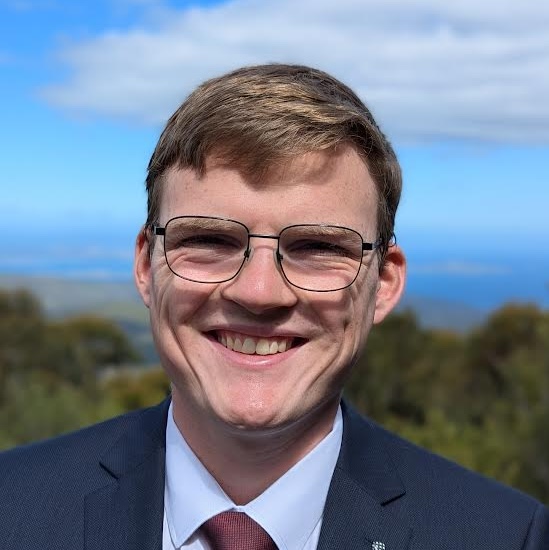
William Sinclair
William is an economist and mathematician.
“People on the progressive end of the political spectrum have legitimate questions: Why can’t they just stop new coal and gas? Why can’t they just end the AUKUS program or stand up to Donald Trump or do all the ambitious things that progressively minded people would support?
“This podcast tries to answer these sorts of questions in a compassionate way without the dismissiveness that often accompanies mainstream politics. We try to examine the other side’s point of view without condescension or contempt. I wanted to make a podcast that would rise above the petty politics of gossip, horserace punditry and psychological conjecture on politicians that passes for analysis. I wanted to talk about the thing that really matters: policy.
“I hope our listeners will hear an argument they genuinely find novel and reach their own conclusions about what we’re discussing.”
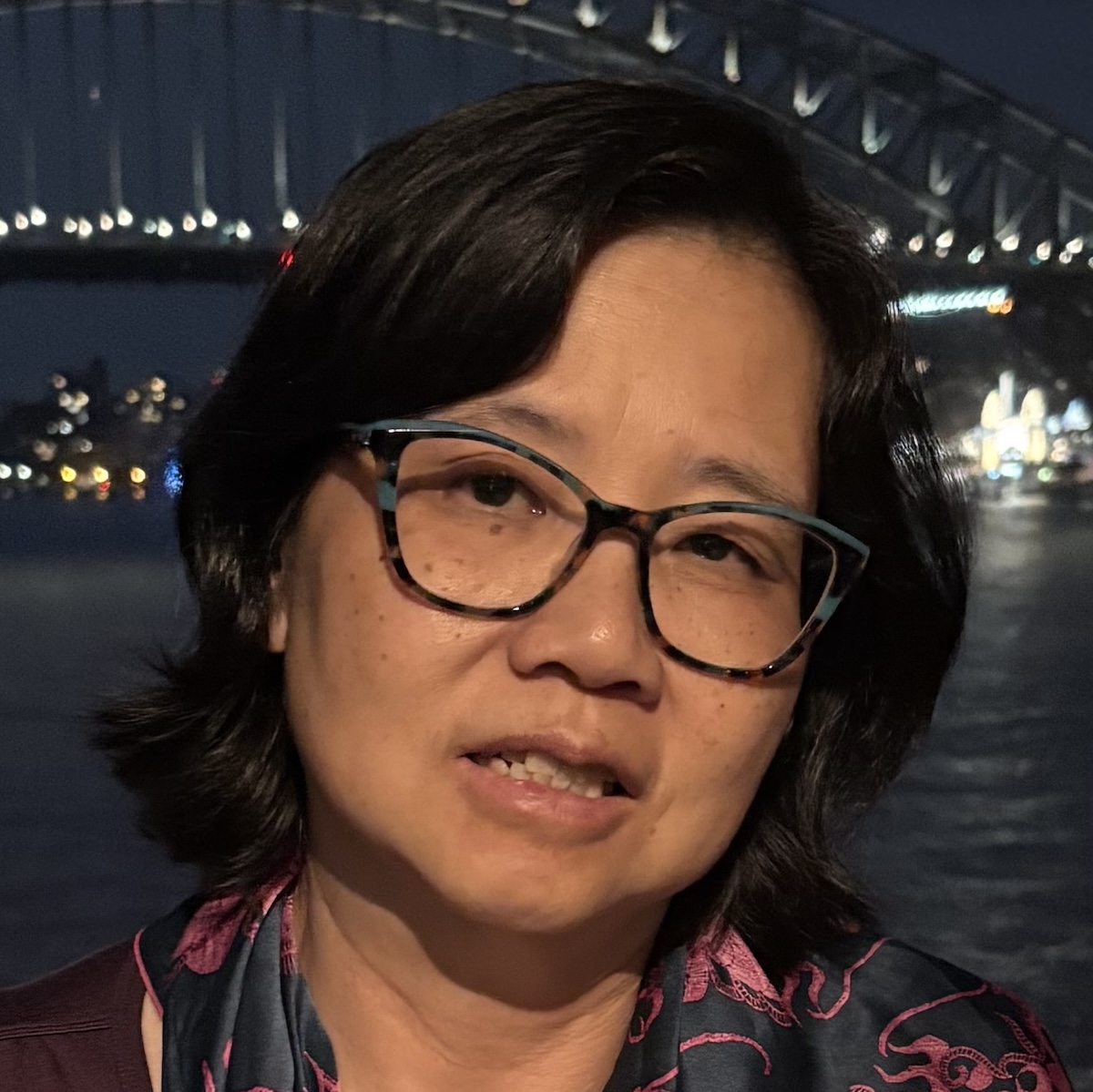
Janaline Oh
Janaline is a former diplomat and current climate, environment and anti-racism activist.
“As a longstanding Canberra-based bureaucrat, I believe in the power of policy to shape and improve lives. I am also acutely aware of the importance of having those policies understood by the people affected by them.
“I started Why Can’t They Just? as way of moving beyond slogans and into what policies really are and what they mean for real people.”